


The more pervasive AI gets, the more anxious teens and young adults feel about it.
That’s based on data from a new Gallup, Walton Family Foundation, and GSV Ventures study released today, which shows that Gen Z is souring on AI.
It also confirms that the two Gen Zs are experiencing AI differently, a trend we started to see surface last year. This makes sense, given that students in Gen Z 1.0 had no exposure to AI in high school (or even college, for some Zillennials like me), while students in Gen Z 2.0 have already experienced the rise of AI in school.
How they are using it:
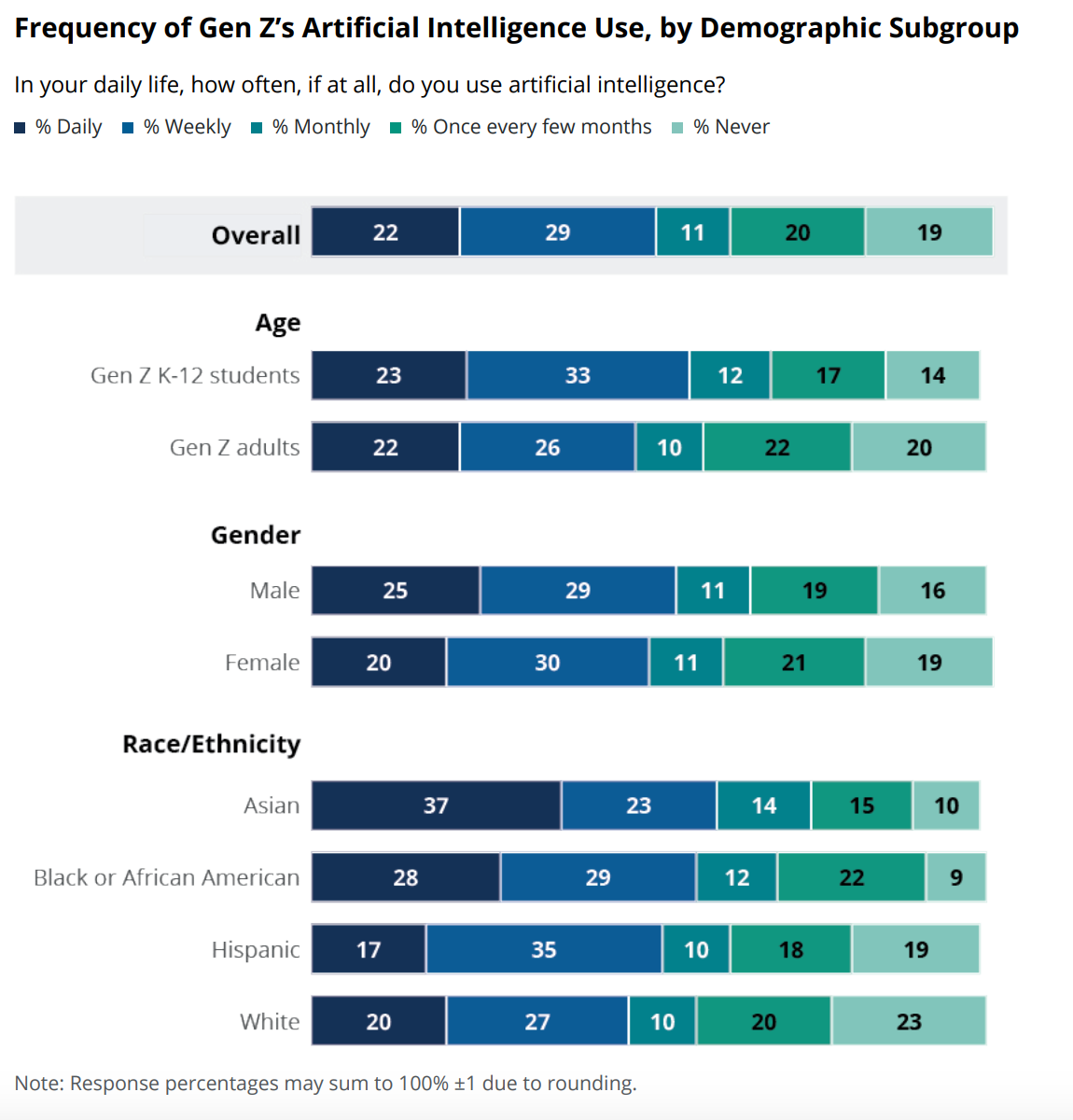
More than half of Gen Z uses AI at least weekly
Gen Z 2.0 (14-21-year-olds) are using AI more regularly than Gen Z 1.0 (22-years-old and up), they’re also less anxious about it than their older peers
How they feel about it:
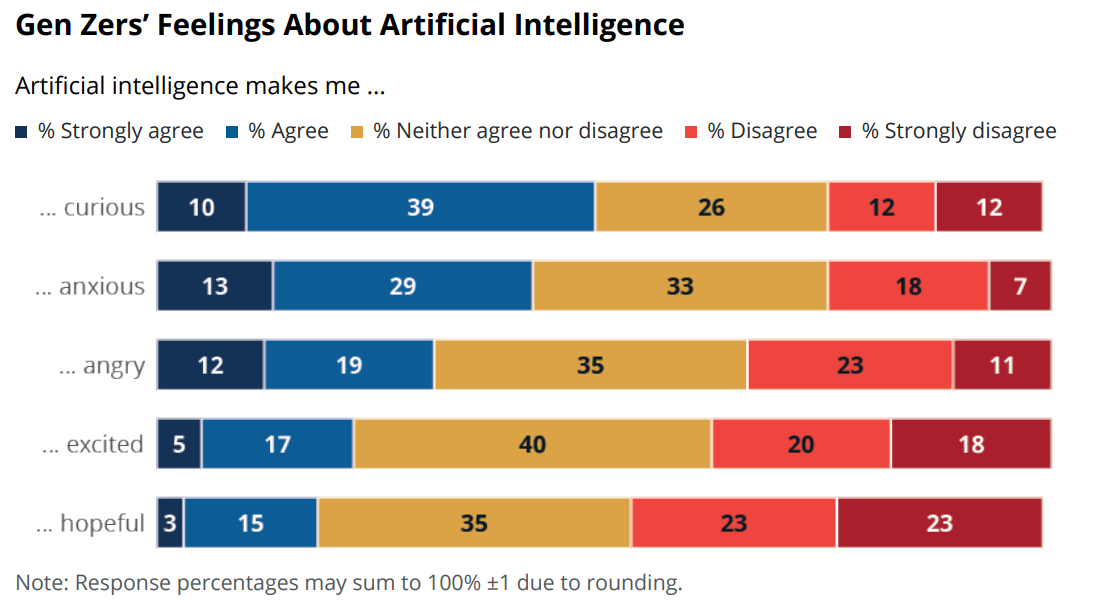
Only 22% of Gen Z is excited about AI
Only 18% are hopeful about AI
Nearly a third of Gen Z feeling angry about AI
Yet, more than half of Gen Z students believe they’ll need to know how to use AI in education after high school
There’s a racial divide: Black and Asian Gen Zers are the most likely to use AI regularly.
Workplace worries: About half of Gen Z employees see more downside than upside to AI at work, while just 15% see the tech as a “net-positive.” Men and college-educated employees are the most likely to use AI at work.
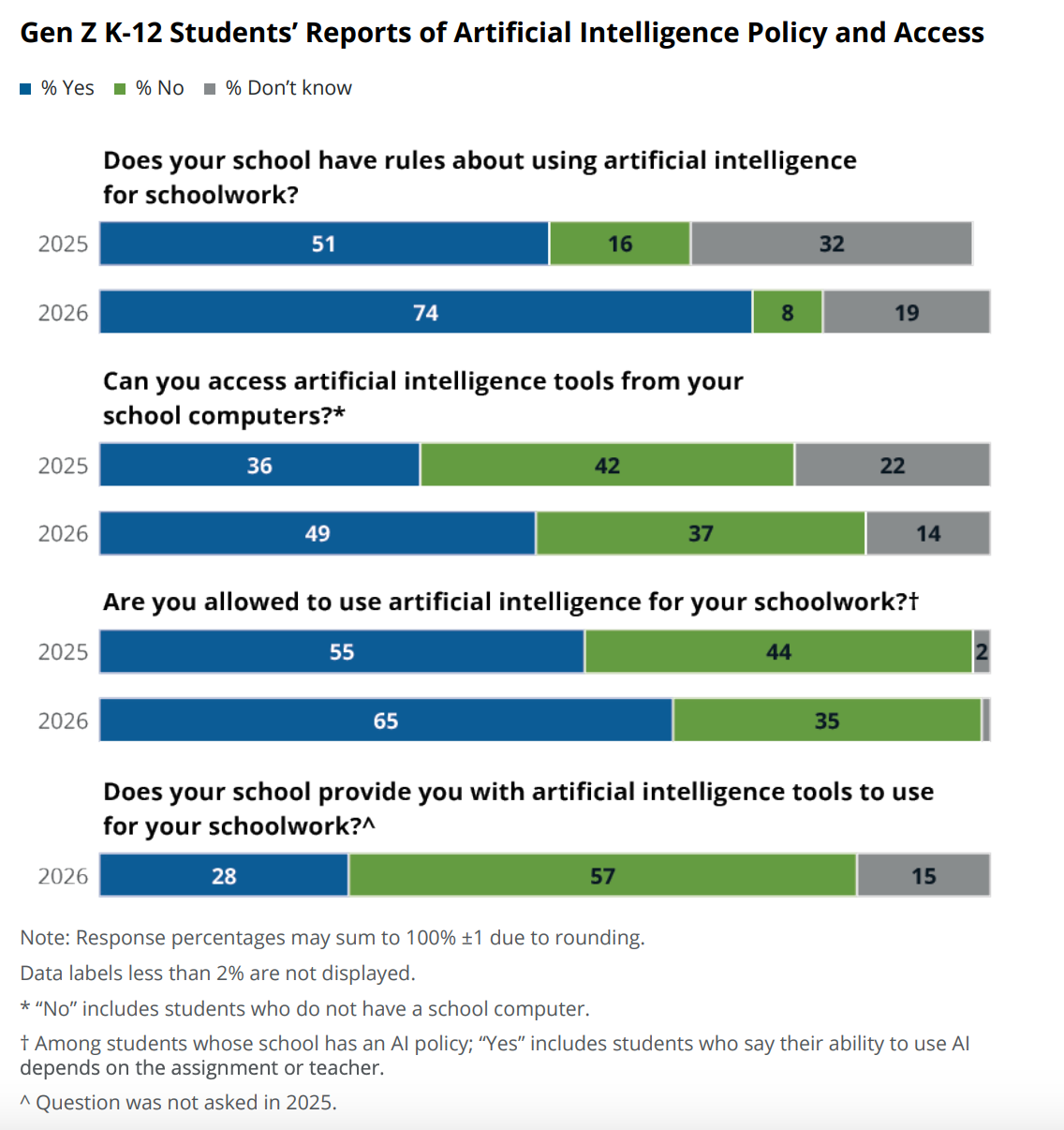
But growing educational impact: Broadly, schools’ relationship to AI has changed over the past year, with more access to and also more school policies around AI.
Parental permission: As AI’s impact increases, conversations between parents and children are changing too. Nearly 60% of Gen Z K-12 students have talked to their parents about AI.
This survey data comes alongside the ongoing ‘Voices of Gen Z’ Study with Gallup and the Walton Family Foundation. Data from this series has been important for making sense of how Gen Z feels about their futures and present, especially when it comes to school and work, and shed light on Gen Z’s rightward shift well before the 2024 election. The Walton Family Foundation also supports my work on these topics.
AI is the biggest storyline for our generation right now. At The Up and Up, we’ve been tracking how both students and young adults feel about AI for quite some time — in fact, it’s been one of our biggest priorities over the past year.
My other Gen Z AI-focused writing:
Gen Z Uses AI But It Makes Them Anxious, The Up and Up, April 2025
Gen Z & AI in the Heartland, The Up and Up, May 2025
Opinion: The AI cheating panic misses the point, Washington Post, August 2025
The AI Policy Craze, The Up and Up, January 2026
Good Luck Banning AI, The Up and Up, February 2026
Gen Z’s Gut Reaction to AI, The up and Up, February 2026
Gen Z Has a Love/Hate Relationship With AI, The Bulwark, March 2026
Just last night, on our April ambassador call, high school and college students stressed what they’re calling the “death of the dream job” as a result of AI anxiety — and how they’re preparing for workforce changes amid the new tech. They also touched on what they called ‘AI etiquette’ concerns in education i.e. when teachers and students respectively should use it vs. how they are currently using it.
I’ve written a lot about Gen Z and AI, but today’s findings gives us the most recent snapshot of how young people feel about how dramatically the quickly evolving technology is impacting all parts of their lives. It complements our qualitative research in recent Reality Checks, listening sessions, and community calls.
Let’s hear what our community has had to say firsthand…
In our latest Reality Check with our Gen Z community, we asked respondents to tell us the biggest thing older generations don’t understand about their experience with AI.
Here’s some of what they told us:
“I/we as a generation have to learn to use it in order to survive (in the workforce) in the coming years. They think it’s us being lazy, but in reality, we need to know how to use it so that we don’t loose our jobs to it.”
“AI isn’t just a cool new tool for us to use, but is something that is actively threatening our futures, both in the job market and environmentally by exacerbating the climate change crisis,” said one of our 20-year-old ambassadors from North Carolina.
“I don’t use it to cheat or anything, but I use it to help make practice problems for me for Physics or Calc AB. It can also show how to solve various questions that I might need to know before my test. I try to limit the amount I do use it because I understand the amount of water it uses.”
“It’s really infiltrating every segment of society from school to work to fitness to dating advice to being a therapist. It can do almost anything better than humans.”
“I don’t think they understand that I don’t use it very often (but I think I am in the minority).”
“There is significant pushback from liberal young people my age against AI. It is accused of taking jobs and the risks of data centers, misinformation and learning loss are well known. My generation actually makes fun of older generations for over-relying on AI, as it is a technology that is very easy to pick up and many of us see our parents using an unhealthy amount of it,” said one of our 18-year-old ambassadors from Arizona.
“AI is not magic. It is still developing and makes mistakes. And my enthusiasm for it is not high.”
“I don’t think they’re understanding how it is impacting my ability to get hired,” said one of our 19-year-old ambassadors in New York.
“How AI can be super useful for research. I feel my older professors are still wary of its use entirely.”
“AI isn’t replacing our thinking but it is reshaping how we start thinking. It’s a tool, not a personality. We still have to direct it, edit it, question it. The skill is discernment, not dependency. Older generations sometimes see it as cheating or as magic. It’s neither,” said one of our 17-year-old ambassadors from Arkansas.
“I think it’s a lot harder to figure out what’s ours now. With AI, the line between what are my ideas, my writing, my thinking and its ideas, writing, and thinking is much harder to distinguish.”
“I am mad at myself because I find myself using it too much. I think it’s an amazing thing but I don’t think it should be used in schools. It’s making people dumb and reliant on a piece of technology instead of them relying on their knowledge,” said an 18-year-old in Ohio.
“That I fear not having time to work in a meaningful career and make the progress towards a worth while future due to Al.”
“I hate it, and it’s not just a tool to help out. It’s taking our data, water, and resources and it is way more harmful. The simplicity of it makes it the best weapon against humanity,” said a 19-year-old in Pennsylvania.
“They don’t fully get how integrated it is into everyday work and learning. It’s not just a shortcut, it’s becoming a tool you need to know how to use well.”
The Up and Up’s take
A few things stand out in these comments about AI:
It’s being politicized.
They’re incredibly wary of the environmental toll.
It’s fueling economic anxiety across the entire generation.
The quiet drumbeat about Gen Z’s economic anxiety has been present since 2024. A few years ago, I wrote that despite headlines leaning into Gen Z’s embrace of social and culture war issues — or the manosphere — the economy was their number one concern. That’s obviously still true — and in many ways it’s driving the gender divide I often talk about. Young adults’ economic anxiety has been the cornerstone of any successful campaign that’s reached young people in the past few years (Donald Trump, Zohran Mamdani, etc). It’s the biggest issue facing Gen Z today and is the most important storyline of our generation. And it’s heavily interwoven with how they feel about AI.
But Gen Z’s feelings about AI are more than just their fears of what the technology is doing to the economy and the job market. They’re worried about what it’s doing to the climate — and its human toll.
The irony of having grown up lonely, online, and amid Covid, is that Gen Z, and Gen Z 2.0 especially is hungry for everything IRL.
So when young adults talk about AI, and say they worry as much about what it’s doing to humanity as how it will affect their education and careers, it’s all part of the same puzzle — about their social and emotional wellbeing, and their calculus on how stable they will feel, as employees yes, but also as human beings.
That dynamic is not only effecting their educational and professional experiences and choices, but also their relationships — and their politics.