

“A successful campaign in 2026 must operate like a full-time production studio.”
That’s the argument at the center of a recent New York Times op-ed from Democratic strategist David Plouffe — the architect of Barack Obama’s campaign and a senior adviser to Kamala Harris’ — who argues Democrats need to act more like influencers, turning their message into constant, made-for-social content.
The piece poured fuel on an already lit fire among Democrats still trying to figure out what went wrong in the 2024 election — a result that surprised many even though it probably shouldn’t have, given there were plenty of warning signs.
Plouffe has a point (even if making the case for influencer politics through the New York Times opinion page is, in itself, a very old-media move). But there’s more to winning in 2026 (and 2028) than turning every campaign headquarters into Barstool. Not every candidate has the personality to pull that off — and when they don’t, voters can tell. More importantly, Democrats risk misreading a strategic, political problem as a tactical, media one.
Here’s my view, informed by conversations and listening sessions with thousands of voters, mostly young ones:
In 2026, the most successful politicians will do two things well.
They will listen closely enough to understand what their constituents are actually dealing with.
They will be everywhere, always, all at once — without seeming robotic or fake.
Operating like a content studio can help with both of these things. But it’s not the strategy itself. It’s the vehicle. And there are plenty of slick content operations deploying the right tactics, but with the wrong message.
To win on the internet, you have to have to understand it. The savviest digital operatives are the ones who actually know how the world online works — which means they’re always scrolling. They don’t post in overly produced paragraphs (or form-template reels) or stale talking points or yesterday’s memes. They post like real people talking to other people. They know when to take risks and also that any imperfect post or faux pas will be irrelevant by the next time they post.
*Remember when Senate Democrats flooded Instagram feeds with a scripted video last year?*
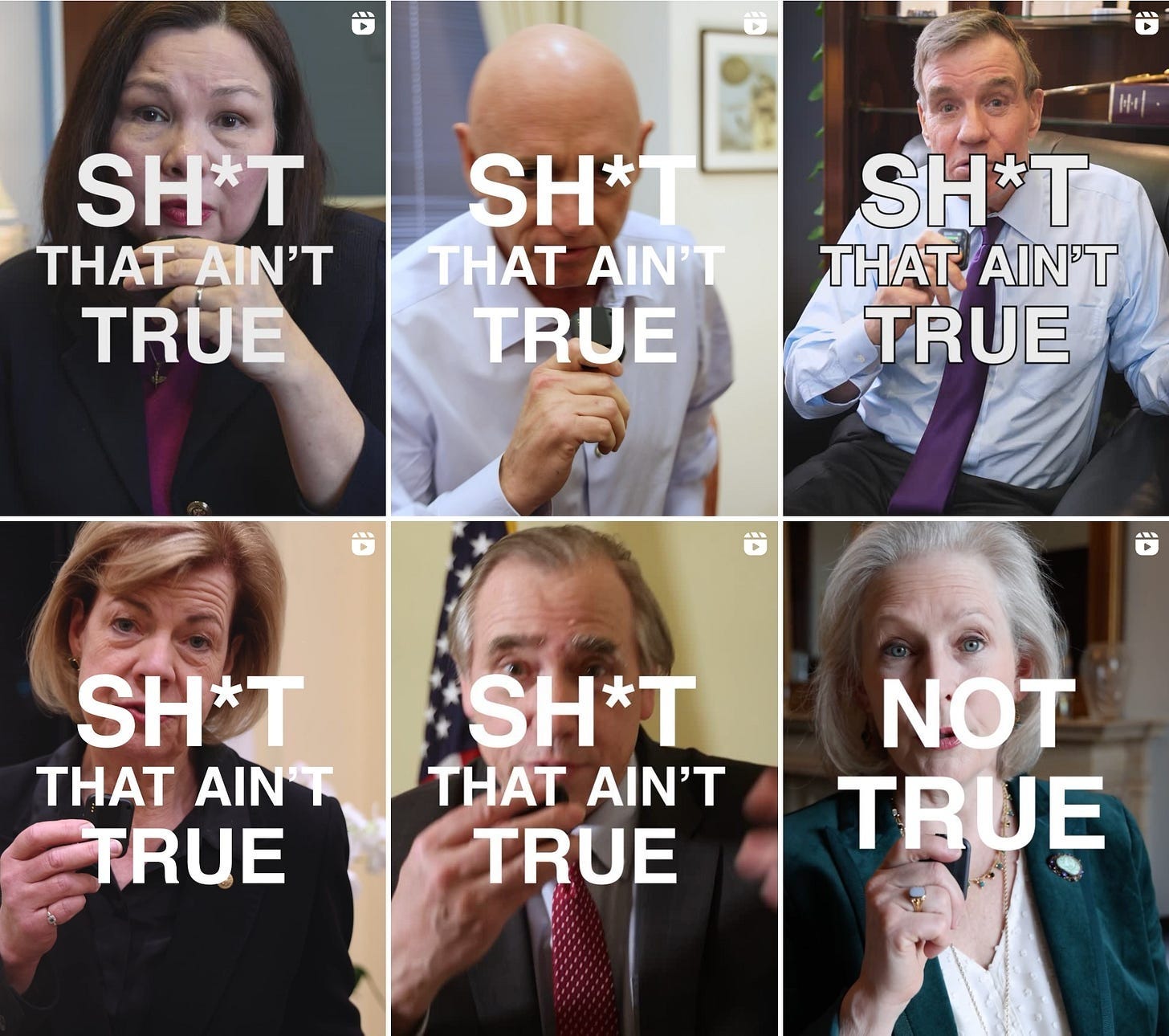
But this is more than just being too online — digital culture is often a reaction to real-life frustrations, needs, and experiences.
And at the end of the day, it comes down to cultural fluency. Like it or not, this is why our reality-tv-star president is president again. For a time, maybe better than anyone else, President Donald Trump had a feel for what people wanted to hear — and how to make them feel seen. I’ve written before about the similarities between Trump’s 2024 campaign and Mayor Zohran Mamdani’s style in New York City. What they share (or shared, because I honestly think Trump lost this touch) is definitely not ideology, it’s instinct. They have an ability to sense what resonates and deliver it in a way that feels natural. They’re not tacking to trends. They’re operating in a voice that feels completely their own.
Media matters enormously but it is not everything. The notion that politicians should communicate directly to voters through their phone screens isn’t some great revelation. In a different era, that would have meant newspapers or cable. Important, of course. But no medium can compensate for a weak message.
You should only say something if you have something worth saying. And that’s where Democrats still seem stuck. In my listening sessions with young Americans, the complaint I hear over and over is that Democrats don’t have a clear message. That was true in 2024, and it may be even truer now.
I think of a young woman who told me, “the last time I heard about Democrats rallying together was during the shutdown,” meaning only when they were playing defense. Or the young man who described the party as “a chicken running without its head.”
Or the young woman who told me the Democrats only message is “we’re not Republicans.”
Young Americanas are not demanding purity politics or litmus tests but they are asking for some glue — a unifying vision, a sense of direction, and a reason to believe the party stands for something beyond opposition.
Personality matters but a bunch of personalities online alone can’t carry a party without a coherent vision for what comes next. (That challenge is compounded by the fact that many young voters no longer feel particularly attached to party labels or drawn to today’s political candidates at all.)
Which leads me to my final and most important point.
The core job of a candidate is to listen. It’s not to produce content. If clips from real conversations help show understanding and reach more people, great, but the human element has to come first. Otherwise, voters will feel the difference.
One of the clearest social trends of the past few years has been Gen Z 2.0’s so-called analog revival. Yes, younger audiences are online. But they also crave a life lived in person.
One of the biggest critiques I hear from young people is that, when it comes to politics, they feel like an afterthought, or like candidates only show up to talk to them just before an election. One of the biggest compliments I heard in 2024 (and this was true of Trump, even if his actions were performative), was that he showed up, on campuses, at frats, at McDonalds, at UFC fights.
Politicians should take that seriously. Actually go to where people are.
Go to community hot spots. Show up in places where culture is being formed and lived. And while you’re there, listen. Have a conversation. Ask them what’s going on in their lives. Really engage, one-on-one.
Some of those moments may later make for strong political content. Maybe that looks like Mamdani’s viral walk across Manhattan, or Texas Senate candidate James Talarico giving an Easter Sunday sermon.
But if the main goal is capturing the moment instead of actually living it, people will feel that too. There is a time and a place for cameras and memes. But if politicians become too fixated on turning every interaction into content, content itself can become their Achilles heel.
Noteworthy reads
What Teens Are Doing With Those Role-Playing Chatbots, Kashmir Hill for The New York Times
The Real Religious ‘Renewal’ Happening in Gen Z, Luis Parrales for The Atlantic
Inside the Gen Z Shark Tank where influencers are becoming venture investors, Leo Schwartz for Fortune
Nearly half of young Jewish American women are dating less over antisemitism fears, Danielle Cohen-Kanik for Jewish Insider
AI ‘Slop’ Is Flooding Children’s Media. Parents Should Be Very Alarmed., Emily Tate Sullivan for The 74
Great Rachael we Love you. !!!!
The big problem is that Democrats are used to the old playbook where Republicans are primarily in charge - they won every election from 1968 to 2004 but three. This playbook worked in 2020 because Republicans still embodied the “establishment” for many (especially the youngest voters), but in 2016 it didn’t work and in 2024 it was even more outdated.