


Welcome to Gen Z’s dating deficit.
Just one in three unmarried young adults ages 22-35 are dating, but more than half want to be dating. That’s according to a report from The Institute for Family Studies – a conservative family policy think tank – and the Wheatley Institute at Brigham Young University.
And while the media loves to harp on Gen Z’s sex lives writ large, let’s be clear, this data is really mostly focused on straight Gen Z 1.0 and younger millennials in their early thirties. (Those in Gen Z 1.0 are roughly currently 29-24. Those in Gen Z 2.0 are roughly currently 23-14.) My read is that the issue, based on this data and the listening sessions I conduct regularly for The Up and Up, isn’t that young people have opted out of relationships altogether, it’s that more and more of them seem stuck on the step before one begins.
Not all of Gen Z is moving through this in the same way, and there’s (inevitably) a clear gender gap surfacing in the dating data.
The Family Studies Institute report, called ‘The Dating Recession,’ found that:
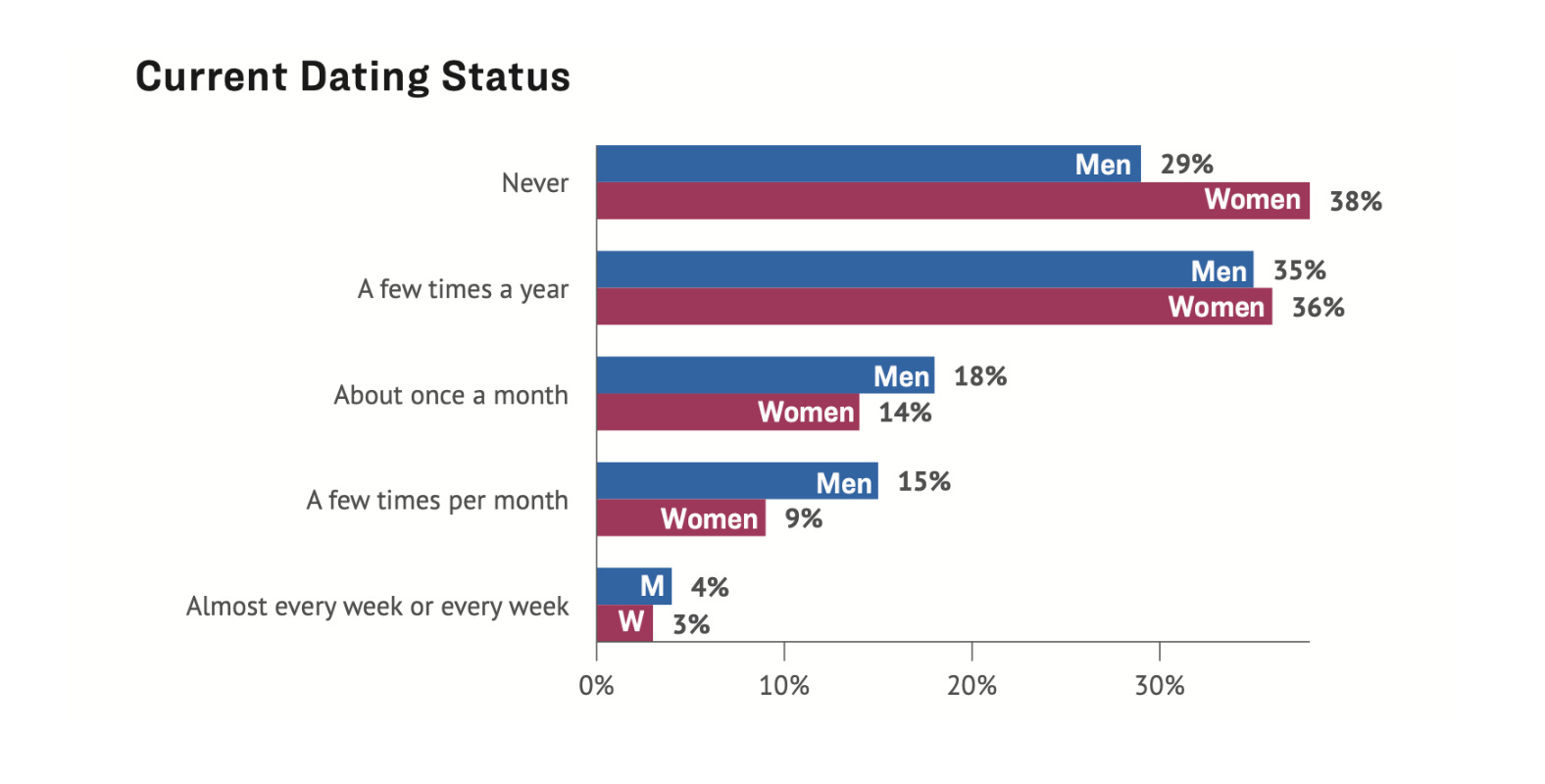
26% of young adult women are “active daters” meaning they date 1x a month or more, while 36% of young adult men are “active daters”
74% of young adult women said they “had not dated or dated only a few times in the last year”, the same was true for 64% of young adult men
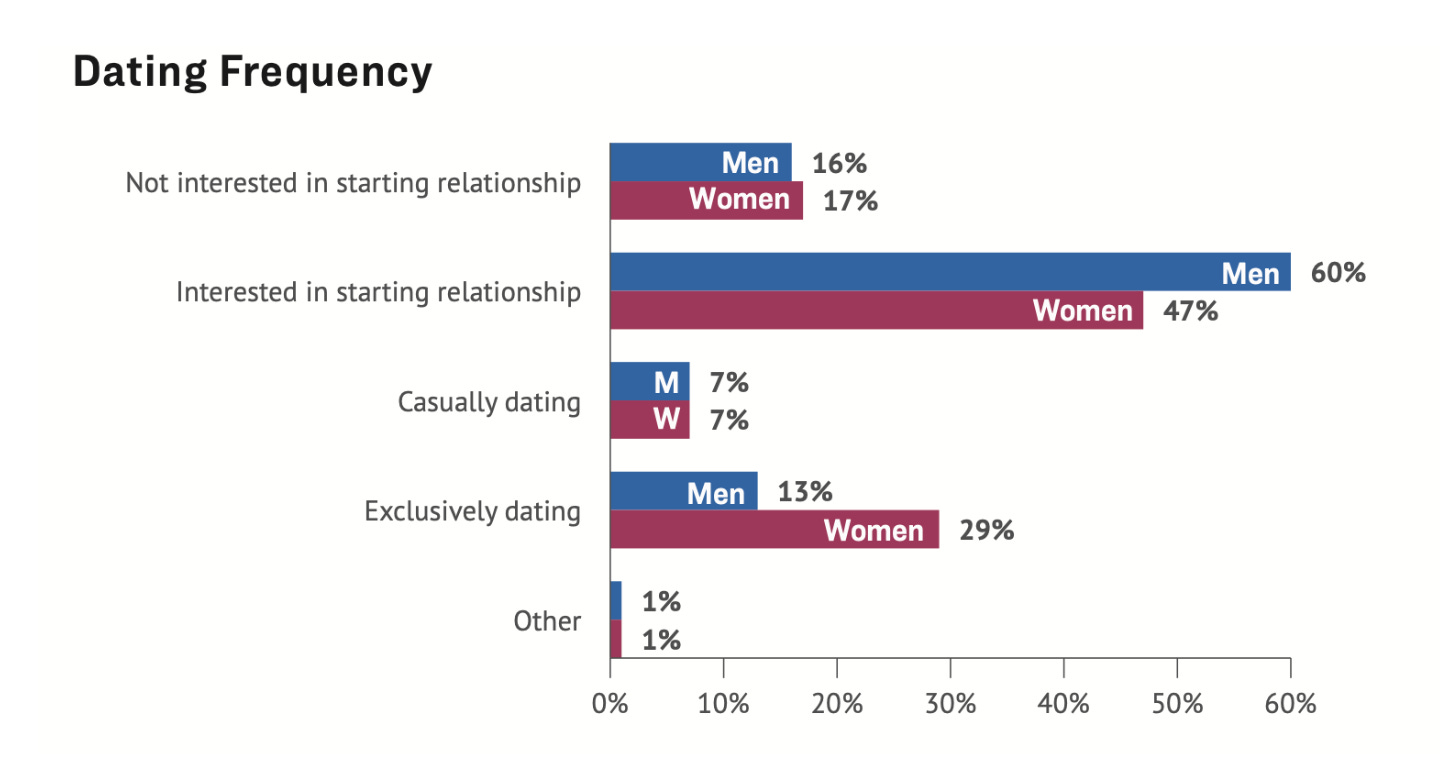
At the same time, 51% of all young adults surveyed said they’re interested in beginning a relationship (moreso for young men than young women).
So the math isn’t exactly mathing. What’s holding them back?
Well, there’s a clear confidence gap. When asked specifically about the biggest barriers to dating, nearly half of all young adults said a lack of confidence is a hurdle. It ranked just below not having enough money for dating activities, something we’ve covered for a while at The Up and Up.
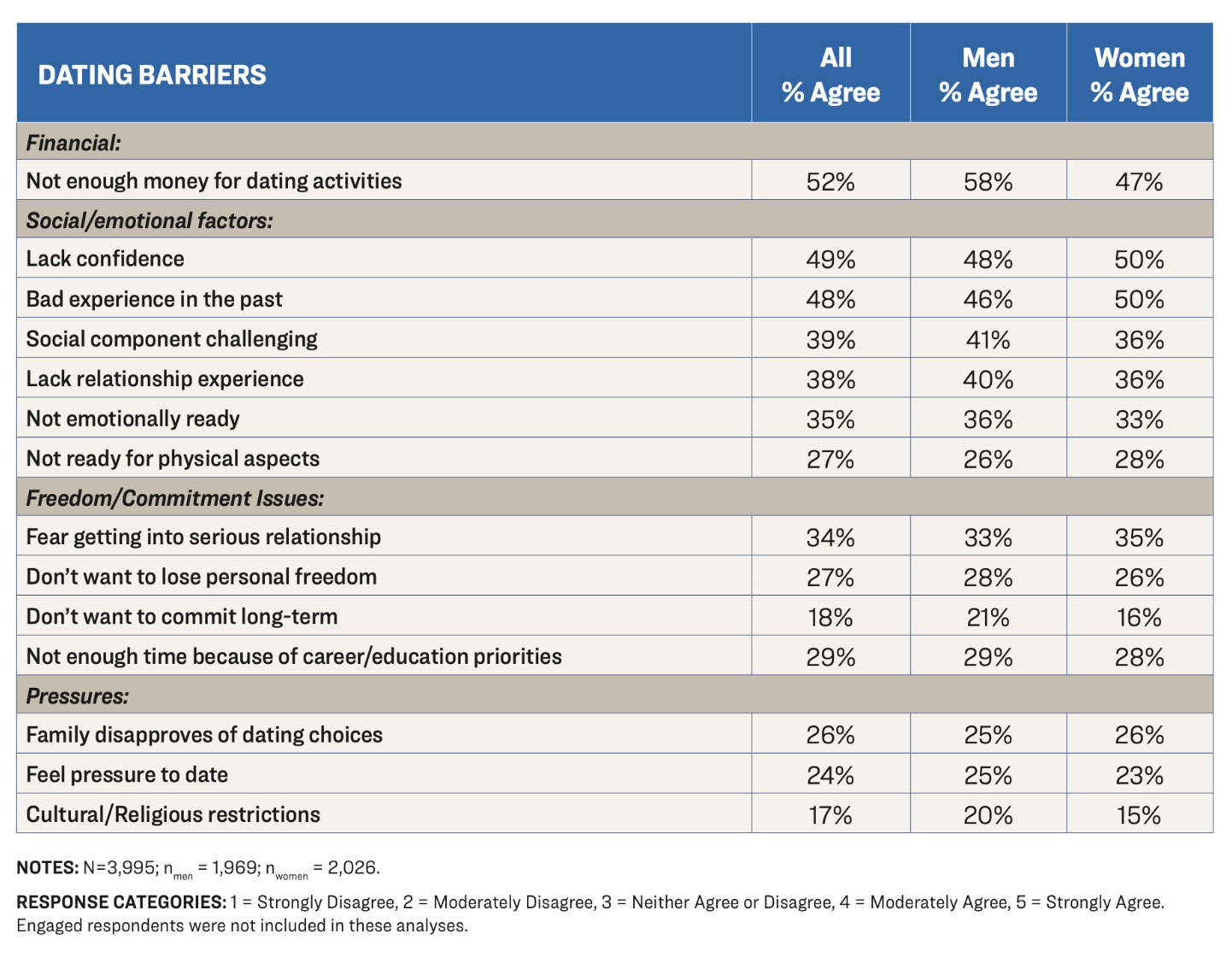
And the deeper you get into the data, the more obvious that confidence gap becomes.
Just one in three young adults feels confident about their dating skills
Only one in three young men say they feel confident in how to approach a potential partner. For young women, that number drops to one in five.
The survey also found that:
Only 37% of young adults trust their own discernment when it comes to finding a partner
34% feel comfortable sharing their feelings with a partner
36% feel they understand social cues on dates
So what? When it comes to Gen Z 1.0’s dating deficit, there are three core factors at play.
The gender divide – More young men want to date than young women, which means the odds are stacked against young men looking for a relationship. On top of that, young men and women are increasingly far apart politically, and for many young women especially, that is a dealbreaker.
A lack of resilience – The older half of Gen Z seems especially uncomfortable with rejection, which is, of course, one of the basic risks of dating.
Compressed confidence – Dating takes courage. It also takes practice. But if young people aren’t dating in the first place, they’re not building that muscle – and the longer they go without using it, the harder it is to start.
So, where do we go from here? Lately, I’ve been having the same conversation over and over with my single friends. Dating apps feel futile (and don’t always lead to an IRL date), and yet it feels nearly impossible to actually meet people in person. So many end up opting out of dating altogether.
On the flip side, as Gen Z 1.0 looks to recycle the 90s, girls night out in the spirit of Sex In the City seems to be making a comeback.

I’ve heard plenty of stories about young women going out in groups, sitting at bars, hoping a group of men will be there too. But this all feels really gendered (and yes, of course, this is only relevant for heterosexual couples). Most of the places these young women are going aren’t necessarily occupied by the young men they’re hoping to meet, who haven’t necessarily caught onto these tactics (though I will say, amid March Madness, I have heard of girl groups going to sports bars in hopes of finding some guys, or in D.C. going the polymarket bar to “monitor the situation”).
Still – if the men these women are hoping to meet aren’t showing up in the same places, and aren’t trying the same strategies, it’s going to be pretty hard for them to find each other.
That more than anything may be the clearest sign of the problem. This is a generation that says it wants relationships, but no longer seems to share a common script for how to begin one.
In the short term, the fallout is deeply individual. There will be more loneliness, more isolation, and fewer opportunities to build the emotional skills that intimacy requires. In the long term, it becomes macro, with fewer durable partnerships, fewer families formed, weaker community ties, and a society expecting a generation to sustain its future without having supported the foundation needed to get there.
Noteworthy reads
Go Viral, Beat Your Rival, Mary Julia Koch for The Wall Street Journal
The Sneaky-Saver Generation, Faith Hill for The Atlantic
Have You Seen the ‘Gen Z Pout’, Callie Holtermann for The New York Times
What’s Cool in High School? Personal Finance, Oyin Adedoyin for The Wall Street Journal
Democrats Need a New Promise: A House by 30, Rotimi Adeoye for The New York Times
Excellent insights!
Really profound insights. Thanks for sharing.