


Young men hate the political establishment. But they sure are big fans of former President Barack Obama.
In fact, more than half of young men ages 18-29 say they look up to him, according to a new report from the Institute for Family Studies, a conservative family policy think tank.
The report shows that of all public figures asked about, Obama ranked the highest, clocking in above Lebron James, “the online influencer you follow you most closely,” Elon Musk, President Donald Trump, Mark Zuckerberg, Joe Rogan, John Legend, Pope Francis, and Andrew Tate.
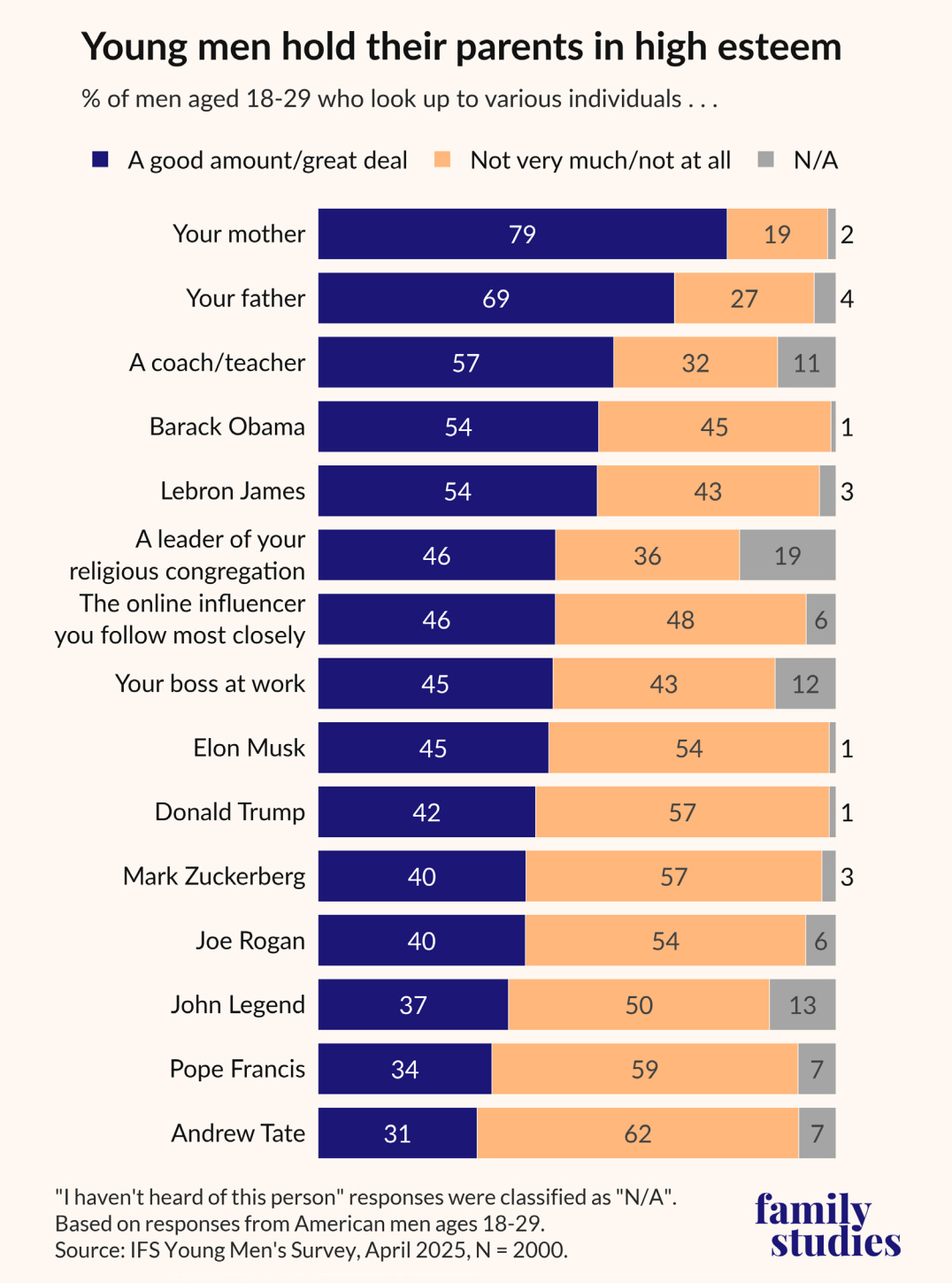
That’s not an isolated finding. A report from the ‘Speaking With American Men’ initiative reported by Puck earlier this year shows a similar trend. In that survey, Obama also ranked highest in terms of favorability of any public figure amongst young men ages 16-29 at 56%, outpacing MrBeast (55%), Rogan (53%), Trump (46%), RFK Jr. (44%), Tate (35%), and J.D. Vance (33%). *Yes, Tate ranked higher than the current Vice President in that specific survey.*
There’s even further proof. A Blueprint Research poll from October 2024 showed that Obama ranked as the top political figure for young men ages 18-29. At the time, his net favorability amongst this cohort was +38 points, remarkably higher than Trump, whose net favorability was +6, former Vice President Kamala Harris, whose net favorability was +5, and former President Joe Biden, whose net favorability was -23. To top that off, when it comes to monumental events, the election of Obama had a net +27-point positive rating from young men ages 18-29.
So why, exactly, are Gen Z men so Obama-pilled?
The simplest explanation is not that Gen Z men are secretly more liberal than they appear, or that they’ve suddenly rejected anti-establishment politics altogether. It’s that Obama no longer reads to them as “the establishment.” Instead, he represents something that feels largely absent from public life today — political leadership without chaos, and masculinity that isn’t performative.
That helps explain the apparent contradiction. Obama is, on paper, the establishment. He is a former two-term president, U.S. senator, and lifelong institutional politician. But for many young men, especially those who came of age during the Trump era, he feels less like a symbol of the system and more one of a coherent time. His style (measured, confident, aspirational) feels both distant and appealing.
Part of that appeal is of course nostalgia. We know Gen Z is drawn to a past they don’t quite remember, whether in politics, culture, or aesthetics. They’re seeking hope (it’s why we see candidates like James Talarico and Zohran Mamdani doing well with young people) and recycling millennial trends. Obama belongs in that category. He is culturally distinct in ways that older politicians are not. He’s contemporary and recognizable, but distant enough to stand apart from how exhausting our current reality is.
And then there’s how Obama signals positive masculinity. When it comes to the leadership young say they value, the Institute for Family Studies report reveals an important clue. While masculinity has been stigmatized thanks to locker room talk and the manosphere, young men describe it differently. According to the survey, 89% of young men agree that “manhood involves strength, responsibility, and leadership,” and 85% of young men agree that “being a man requires a willingness to sacrifice for others.”
Obama’s drawn his fair share of criticism. But, at least in retrospect to this group, he fits that mold. He projects a version of masculinity that is composed (not reactive), disciplined (not aggrieved), and fluent in culture (without being consumed by it, or trying to define it himself).
He doesn’t appear to chase attention, but he commands it anyway. That helps explain why young men’s admiration isn’t as paradoxical as it may seem. What draws them to Obama is less of an ideological shift and more of a longing for a long-lost, coherent kind of masculine authority.
Noteworthy reads
In Defense of Influencers, Cyrus Veyssi for TIME
Gen-Z is changing the meaning of “independent” voter, Elena Moore and Brittany Luse, It’s Been a Minute, NPR
Turning Point USA Clubs Expand to High Schools Across America, Michael Anthony Adams, Mark Boyer and Luke Piotrowski for the New York Times
High Schools Are Losing the Struggle to Block Pot—Even During Class, Andrea Peterson for The Wall Street Journal
And watches
Jake Paul recently sat down for a 1:1 interview with President Trump. And Trump recently endorsed Paul for office (but he’s not running, yet). Take a peek.
i only look up to taylor swift
i hope she goes to law school