

IRL summer is well underway, with a helpful boost from the New York Knicks. I’ve never seen the city abuzz with as much energy as it was on Saturday night for the NBA Finals.
Like many New Yorkers, my game-time plans included joining a large crowd in the West Village. It was one of many hot-spots for communal viewing that popped up across the city thanks to the array of social entrepreneurs who thought to livestream the game for their neighbors.
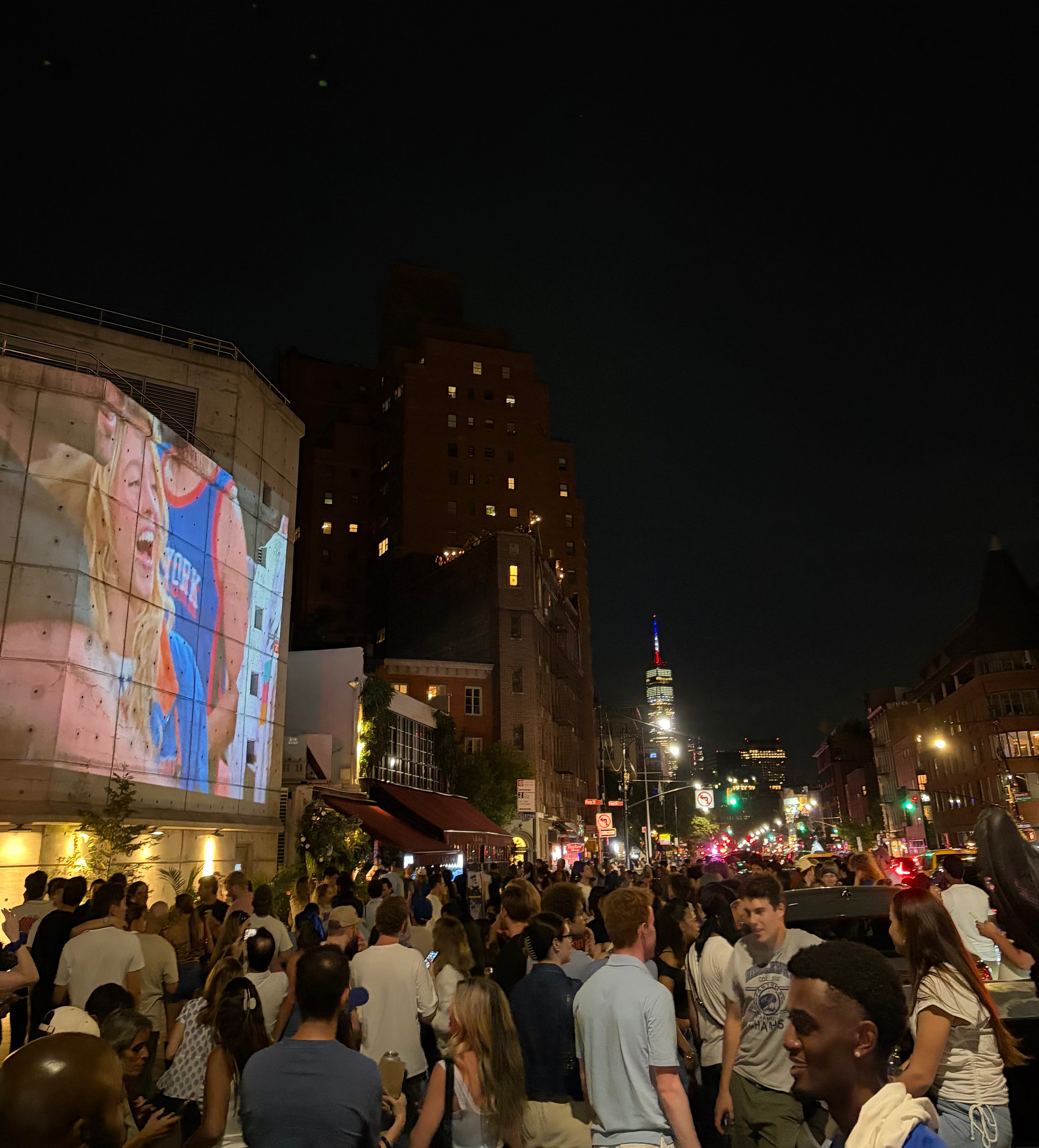
Turns out, that livestream on 7th and 11th Ave was set up by the founders of Hoost, a brand-new marketplace for social experiences — thanks to a projector from Facebook marketplace, good neighbors, and a lot of chutzpah. They scoured the city for a place to project game three – and landed in the heart of the West Village. So they went back again on Saturday, and popped up just around the corner, across from Le Dive (thanks to a tip from a friend who lives next to Apollo Bagels.)
Hoost’s co-founder is Hussain Sheikh, a 23-year-old graduate of Babson College from McLean, Virginia. He launched the platform two and a half weeks ago (before Boston and New York Tech Week) and has been “all over the place” since. Here’s what he told me about their successful NYC pop-ups and what the energy signals for the rest of the summer.
Our conversation has been edited lightly for clarity and brevity.
Tell me about Hoost.
HS: Hoost is an app. There’s a marketplace that lets you book spaces, services, and sponsorships for events and pop-ups. We like to focus on social experiences rather than doing any corporate events. If it is a corporate event, it would be more geared towards the social aspect, because we feel like community and gathering are really important, and creating curated experiences is an awesome thing to do, and it’s very much in demand right now, and we feel like no one else is solving this.
It lets you book spaces, services, so you’ll be able to go and look up a warehouse, rooftop cafes, untraditional spaces as well, such as museums. You’ll be able to book that out by sending inquiry requests to multiple venues at the same time. Then you’ll be able to see what availability and pricing works for you, what matches your buy, rather than you having to go into every single website alone and submit the same inquiry multiple times, filling out the same form. This consolidates that into one place, and then on top of that, you’re also able to book services, think vendors such as DJs, photographers, AV equipment, food and beverage. For food and beverage, we really like to focus on experiential food and beverage rather than just pure catering, because pure catering, you can really just get from anywhere. We like to focus on stuff that almost, if you know Jack’s Dining Room, they do a great example of this, but very experiential, like food vendors, like someone will come and shuck oysters for you, or someone might make pizza in the spot for you, and then hand out slices. Very much in person and connected to the attendees. Our last layer is sponsorship. We’ve been seeing a massive pour of money into brands, or from brands into events.
Why is this type of platform having a moment?
HS: If you look at all the different RSVP and ticketing platforms, their growth is crazy year-over-year. Insane numbers. People are craving community and connection and that’s just something that’s not going to go away. My co-founder and I were already really interested in this industry, just coming fresh out of college, going to parties, going out, studying abroad, just being out and about. It’s amazing, right? Connecting with people, talking with people, experiencing with people is something that is never going away.
And the unfortunate truth is that yes, AI is coming, even though we might not like it. It’s going to take over people’s jobs, unfortunately, and people are going to have more time on their hands… they will have more time to connect with people. That’s the bottom line.
Every single brand is trying to get into an event, and then even niche communities — there’s so many online communities that are craving offline experiences. Offline experiences are just growing through the roof. According to an Eventbrite survey, it’s like 70% [plus] of Gen Z prefers to spend on experiences or materialistic things.
People are also drinking a lot less from Gen Z. That doesn’t mean that you can’t have a good time. There’s sober parties, sober events, events with just CBD and stuff as well. There’s like a wide range of alternatives growing. Because people are drinking a lot less, a lot of bars are unfortunately suffering. So people are going to more of these pop ups and experiences — they’d rather go to the pop up in the museum than go to the same bar that they’ve been going to forever.
You mentioned the power of community — being fresh out of college, going to parties, studying abroad. Is this a post-Covid resurgence?
HS: From 2020 to 2022, that graduation class from high school, but also from college, it’s like you didn’t really have a graduation, you didn’t get to do your prom, you didn’t get to do all this stuff. You had bundled up energy. You wanted to go out and about, and it’s just like right after Covid, the flood gates released, and it’s so much travel, so many experiences, everyone’s trying to do that. You don’t know what you have until you miss it, or until it’s gone. Covid took a lot of that away, but now we’re finally seeing a massive growth back.
Covid was over a few years ago, but it feels like people are socializing now more than any year since then. Why do you think that is?
HS: I think it has to do with AI. New York City is a different beast, because it’s always been going on, and I love New York City. But growing up in DC, in Boston, there’s not so many events happening there, not so many social experiences. Now we’re seeing a trend there, and then even in smaller cities, you’re seeing everyone go to a lot more events. People are starting mini festivals, just from both a social perspective, from the consumer, and then also from a brand perspective.
Biggest takeaway from the Knicks events?
HS: The biggest thing is just do stuff. You can make stuff happen. If you get shut down, it’s not the end of the world for something like this. I’ve never felt, and I’ve been to a lot of sporting events and concerts, I’ve never felt that feeling that I did on Saturday. That is something else. I don’t think you will really get that in any other city on the planet. People want to feel connected.
What are the next events you plan to do this around?
HS: World Cup events. We got reached out to a bunch about projecting Summerhouse.
Will you do anything for July 4?
HS: There’s so many events that are going on in the city and around the states for Fourth of July. So, it’s like, okay, what can you do to stand out, and honestly, the best thing is like what gets in front of people’s eyes super fast? We could sell out an event, but having an experience like the Knicks, projection is a pretty good entry to start that out. So we might play some American classics, like Independence Day, even though it’s a movie with aliens, and some other movies, or some clips, maybe some songs that really resonate with the Fourth of July, and then just building on you have that going on. You might have a DJ somewhere as well, you might have someone serving up hot dogs, someone serving beers, stuff like that. Mixing and matching is really what creates a proper event.
And in an ideal world, what other community moments could you create for people to come together?
HS: The projection is one thing. But we don’t do just projections. I think it was a quote I saw this weekend, sports are the last frontier of collection. It doesn’t matter your political view, your religion, your race, any of that stuff, it just brings people together. So that is something that’s pretty awesome, that we obviously saw. Maybe New York’s like a whole separate breed of community, being New Yorkers, but regardless, it was awesome. I think after that the World Cup is a great opportunity to bring people together.
Another thing would be like TV shows and movies as well, straight projection. But our target events, as I said earlier, are socially oriented events. Our go to market is more like EDM house pop ups, health and wellness events, and then also these projected like streams. So you would have like something like this, and you’d maybe have like a food vendor that was there, you might have like a little bit of entertainment as well on the side, someone doing spray paint t-shirts, out of the box stuff.
We want people to have taste, because taste is the most expensive thing right now, right? It’s something that’s not going to go away, regardless of whether there’s AI, there’s no AI. Having taste is super important, and that taste makes amazing events, and we feel that we have good taste to give ourselves a good kickstart.
What’s one thing people are misunderstanding about how young people are hanging out right now?
HS: People want to go for what their interests are. It’s not a one-shoe-fits-all anymore. It’s really about curation understanding. You might even see a community from Reddit, like 2,000 people, they’ll have enough people to show up to make something happen. It’s about your interests, your passions, stuff that you wouldn’t expect. When I was growing up, if I liked a TV show or something, I would not have expected an event [around it], unless it’s something official from that brand or TV show. But now you’re seeing the most random stuff people are making because they’re passionate about that, they want a sense of belonging.
User-generated pop-ups, essentially?
HS: Exactly. You had UGC online on TikTok, Instagram, but now you’re seeing UGC for events, and UGC for events is a lot more powerful because you can get a lot of really good content from UGC events.
Noteworthy Reads
No Home, No Retirement, No Kids: How Gen Zers See Their Future, Jessica Grose for The New York Times
Welcome to the Praise Kink Era: Why Gen Z Prefers Compliments Over Dirty Talk in the Bedroom, Ashley Fike for Vice News
Did ‘Backrooms’ and ‘Obsession’ Really Kick Off a Gen-Z Horror Wave?, David Fear for Rolling Stone
Why Gen Z is Paying for Silence, Hani Ritcher for Reuters
Great stuff.
Love the idea to interview him! It’s so fun to hear from the people who create such a cultural moment.