


It’s impossible to talk to a young person today without confronting their mounting job and AI anxiety.
Everyone is grappling with our fast-changing economy and workforce — from the high school senior weighing the ROI of college, to the community college student juggling part-time work and their slate of classes, to the four-year college student wondering if their degree really will pay off as they apply to dozens and dozens of jobs.
It’s within this context that the American Service Project — an initiative to inspire a new generation of national service — was conceived. The group is building with a hypothesis that three main factors — economic insecurity, dwindling institutional trust, and our current political moment — are the perfect storm of events making the moment ripe for a new vision of national service; one that centers Gen Z and its future.
“At pivotal moments in American history, our country has responded by bringing young people together in national service to address the country’s greatest challenges and most ambitious projects,” said Vicky Hausman, Founder & CEO of American Service Project. “Today we are on the cusp of an economic transformation driven by AI, while the traditional pathways into adulthood are breaking down for this generation. So we went straight to the source, asking young people themselves about their hopes, their anxieties, and what service would need to offer for them to say yes. What we heard confirms the opportunity: national service can meet this moment, giving young Americans the skills, relationships, and sense of purpose to launch their adult lives.”
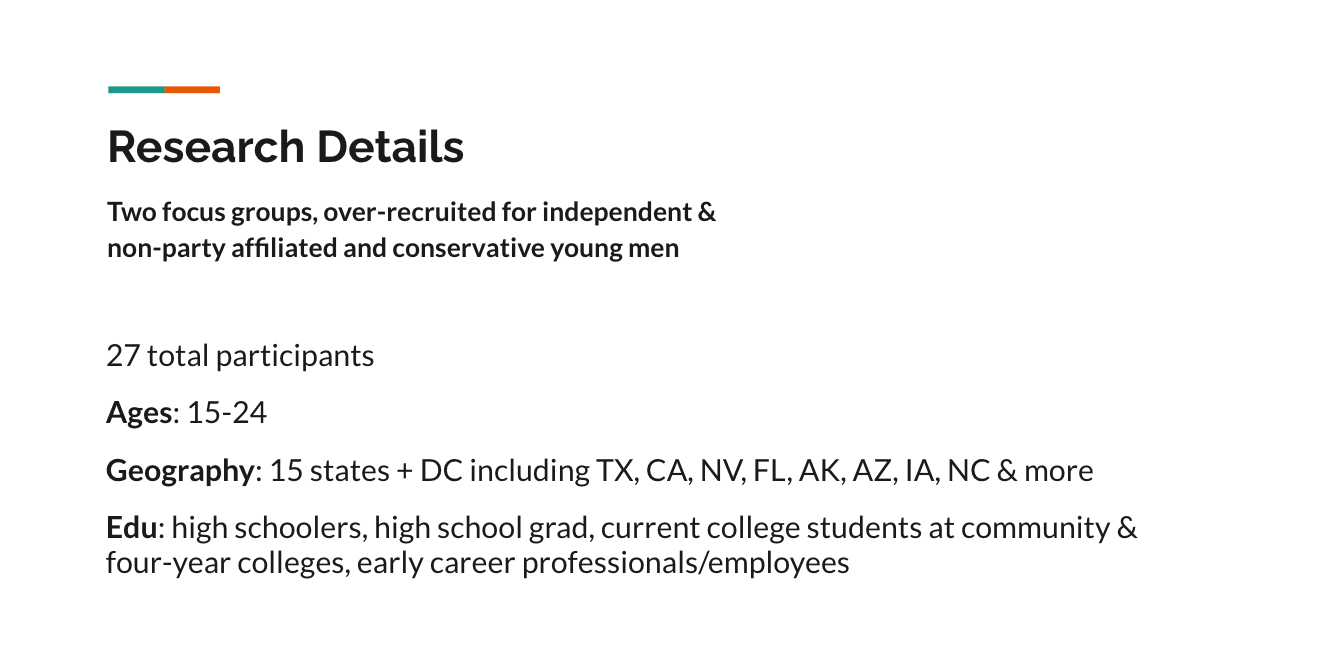
To better understand how Gen Z feels about national service, and whether there’s a generational appetite for the kinds of programs they’re envisioning, I partnered with the group in May for two focus groups with more than two dozen participants — ages 15-24, across a range of geographical and educational backgrounds. We over-recruited for non-party affiliated and conservative young men, given that the service field is often dominated by young women.
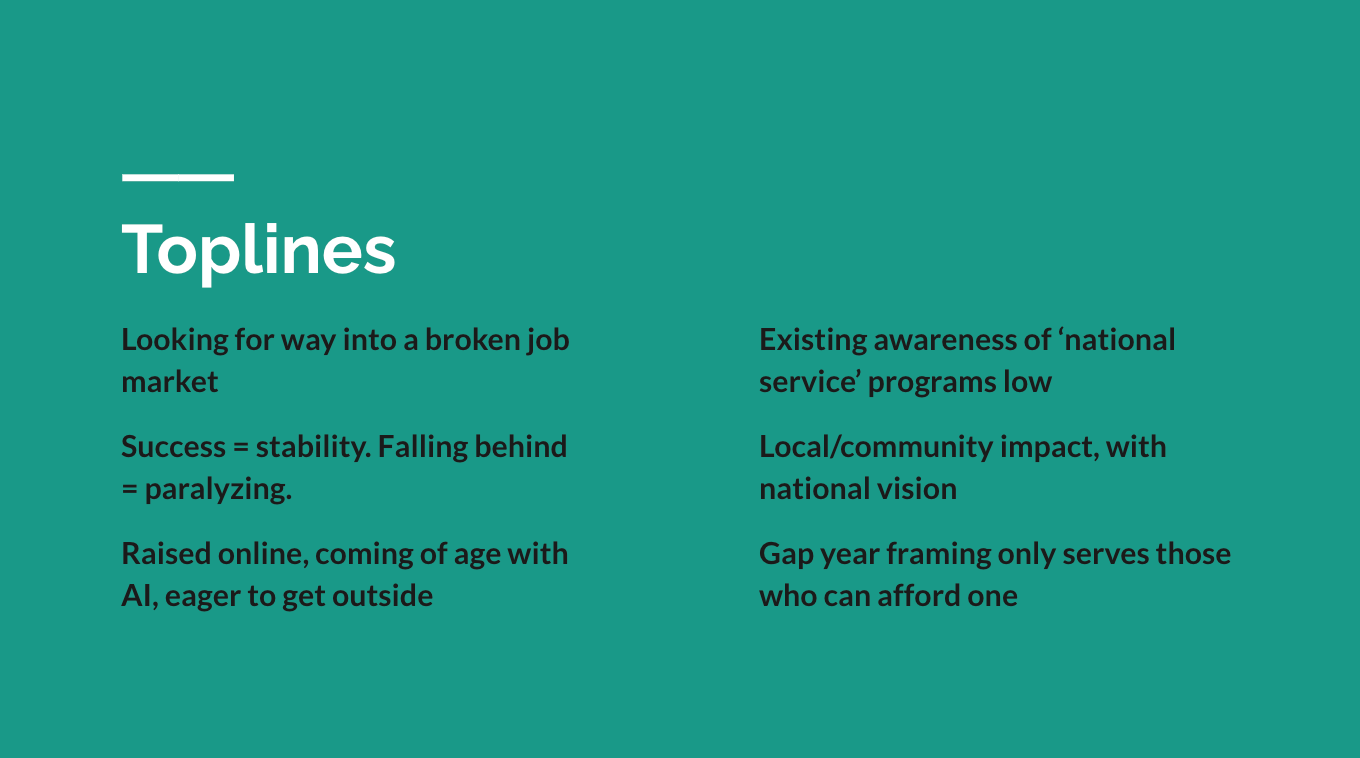
Here’s the TL;DR:
Our research indicates that young adults are generally supportive of and interested in the concept of a national service program for a one to two-year period, so long as:
It’s not mandatory
It doesn’t set them back in their careers
It serves as a launching pad giving them critical skills necessary for the workforce, mentorship, & purpose
Amid COVID and a digital revolution, today’s young adults have grown up questioning their sense of self and their place in the world. And at the end of the day, so much of our generation’s anxiety about the future is rooted in their sense of purpose. Service work, we found, is one possible place to foster it.
Key takeaways
There were many key takeaways from our qualitative research, but a few themes stand out. Read the full breakdown and key findings here.
The job market and pathways to adulthood feel broken, and young people are looking for a way in. We heard young adults describe an employment landscape that feels rigged against them before they even begin. From their POV today, many entry-level jobs demand years of experience, and graduate degrees a baseline. Meanwhile, while white-collar jobs demand years of experience, those looking for service oriented and retail-jobs (such as working at a grocery store, pharmacy, or even ice cream shop) describe an environment where they apply to plenty of job openings and never hear back.
As one 24-year-old in Pennsylvania put it: the job market is “a mess in general.”
And the credential arms race is real. An 18-year-old at the University of Nevada, Las Vegas described feeling that a bachelor’s degree is “a bare minimum requirement,” and that a master’s from a prestigious school is now what actually sets candidates apart.
National service could arm young adults with a structured, credible on-ramp into the workforce.
Success means stability, and the fear of falling behind is paralyzing. When asked what success looks like, participants consistently returned to the same themes: financial security, stability, and family. What stood out equally was the weight of not having a safety net and how that fear is constraining the choices young people feel able to make.
A 19-year-old woman at Morgan State University described it like this: “Opportunities that I feel like young people are missing out on today is the opportunity to really branch out and explore. I feel like people are always like, your early 20s and like going to college is a time to figure out what you want to do. But every time I talk to my friends who may want to change their major or even explore more about themselves, they’re crippled by the fear that they won’t be able to financially support it... So they’re not able to explore their own personal interests as much. And I feel like people are being pushed into things that they don’t want to do.”
National service could provide young people with a structured space to explore and deepen their horizons without financial strain.
Raised online, coming of age with AI, eager to get outside. Young adults’ pushback to the possibility of automation and their already perpetually-online lives is real.
When I asked about the type of work that may be most interesting to them, it was clear how young adults’ priorities are shifting to value hands-on, outdoor, and in-person labor.
“Especially as a college student, it’s important to touch grass,” said a 19-year-old man at Purdue. And a 21-year-old man in Texas said he would appreciate the opportunity to be “outdoors” rather than at a desk job where he couldn’t see the impact of his labor.
Plainly put he said: “I [would] just prefer to be somewhere outdoors where I know I can make an impact and where I’m not going to a job that I don’t want to go to every day.” Young men were especially interested in work in forestry, agriculture, construction, and public lands.
Local impact resonates most, in service of a shared national vision. Young adults’ trust issues generate skepticism in large-scale government programs. That said, when we narrowed the focus to local and community-based work or a smaller project as part of a larger coalition of projects, they were far more interested.
According to a 24-year-old from Pennsylvania, the idea of a New Deal style program that would pay “a wage you could live off” and promote a “broader national vision,” would be beneficial. He’s in favor of “building all of this infrastructure that’s going to get used by people that’s going to benefit all these different people,” rather than private smaller-scale projects.
But we heard a range of input, and participants didn’t all agree on the ranking in value of local vs. nationally focused service.
“I would probably be most interested if it stayed at a state level because I think then they’re better able to equip what their actual states’ needs are the most,” said a 20-year-old from Waco, Texas.
The most vocal proponents of a national coalition were high school students who emphasized the power of shared national goals to overcome the fear of, “What’s one person going to do?”
One major caveat. Importantly, our research proved that as long as national service reads as a gap year from the real world, it only recruits people who can afford detours.
Asked if they’d be interested in a year of service, a 21–year-old woman at University of North Carolina Chapel Hill worried about “feel[ing] behind compared to other people if they’re already starting their careers and already going into the working field.”
An 18-year-old man at Morgan State University said, “I think it’s a great opportunity, but if it interferes with… I guess… a better opportunity, say if I get a full ride scholarship or I have other job opportunities or intern opportunities, that would interfere.”
And a 19-year-old man at Purdue said: “I feel like that would only be beneficial for people who are already in some of the best circumstances possible... most people just aren’t in that boat.”
At the end of the day, our focus groups revealed that any national service program — and truly any initiative meant to reach Gen Z adults right now — must be designed with economic accessibility, incentives, and opportunity at its core.
And there’s a deeper opportunity. The young people we spoke with described service as something that could shape them: build character, teach skills, and give them a story about who they’re becoming. For a generation anxious about its place in the world, the most powerful pitch for national service may be the simplest one. It’s a chance to find meaning.

Service would boost confidence and help heal some hate and anxiety.
love this research and initiative! would love to hear how ASP is doing in six months, a year, etc🙂