

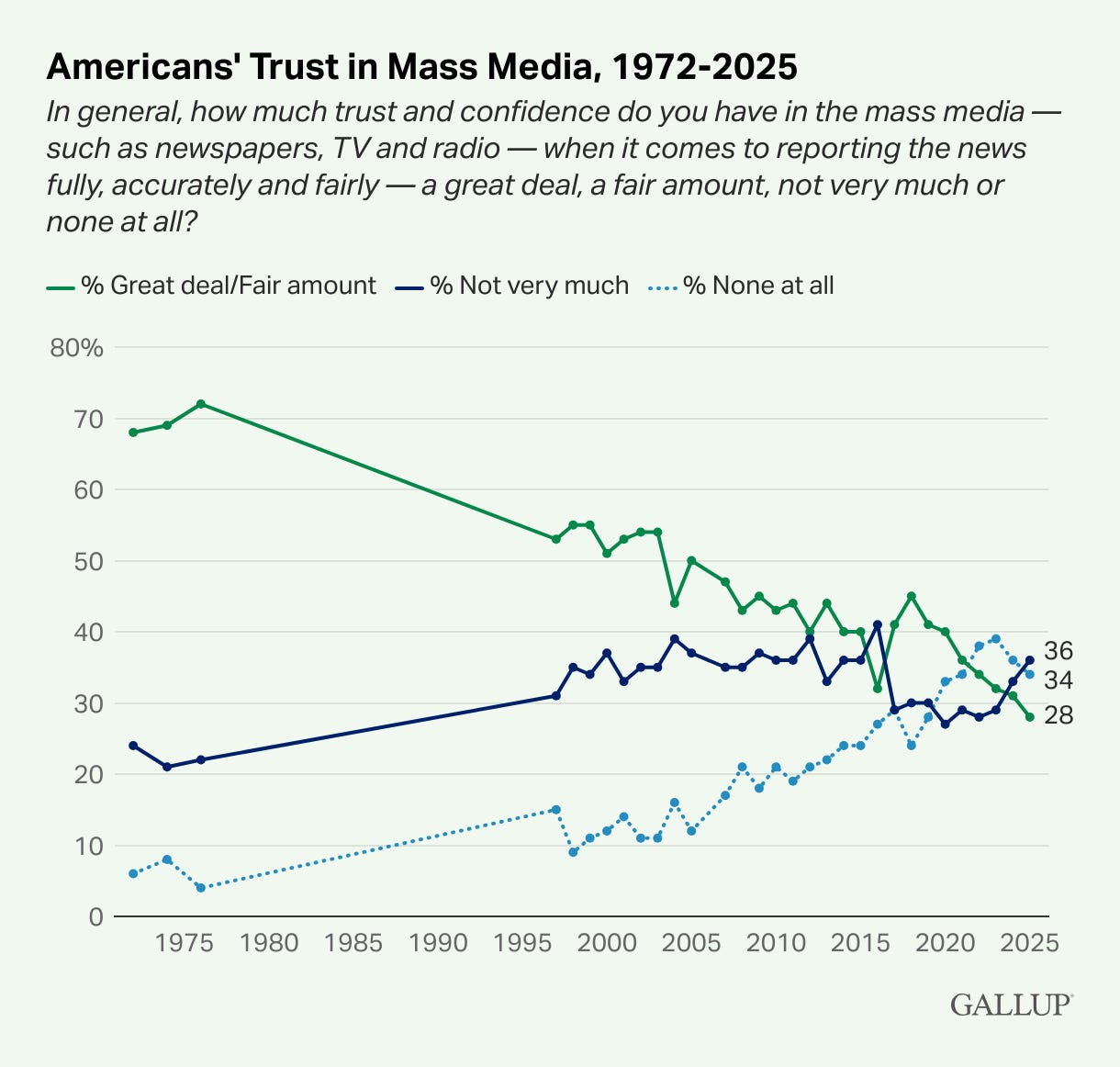
Isaac Saul, a journalist from Bucks County, Pennsylvania, started Tangle News in 2019 with a mission to untangle the news — i.e. rid it of its partisanship, bias, and sensationalism. At the time (according to the Gallup graph below), trust in news was relatively higher than it is today — but Saul was already feeling frustrated by an algorithm-driven media ecosystem that pins liberals and conservatives against each other.
So he decided to create a “big-tent media organization” as he told me – not so that Americans come together and sing Kumbaya — but rather, to give the intellectually curious and politically homeless space to make sense of the world around them for themselves, without being told how they are supposed to think and feel.
Fast forward, and Tangle has more than half a million subscribers, plus another few hundred thousand followers on Tangle and Saul’s personal accounts across Instagram, X, and YouTube. Saul’s work has also been featured in The Free Press, Persuasion, CNN, Fox News, TIME Magazine, and more.
I sat down with Saul to learn more about Tangle, how it’s evolved since he started it seven years ago, and his POV on where media consumption habits will go from here.
Here’s our conversation, edited lightly for clarity and brevity.
Tangle launched in 2019, before the current wave of newsletter media. Tell us about your mission. Who did you originally imagine your reader to be, and who is that reader today?
IS: Our north star is trying to be a big tent media organization. The problem that we recognize is people are in information silos, everybody knows that they’re kind of trapped in their own algorithm, and we all have news consumption habits that tend to pull us towards people who are saying things we already agree with. The social cost of that arrangement is pretty apparent. If you look around, partisanship is really, really bad right now. It’s not just bad like we’re divided, it’s bad like the actual partisanship is pretty vitriolic. People are very angry at each other, very distrustful of each other. It’s incurring a big social cost on the country as a whole.
Our goal really is to try and get conservatives and liberals and independents under one roof with a news organization that they all say they trust, a place where they can go. Not just for a shared set of facts or reality, but a place where they can go observe, read, take in arguments from across the political spectrum, where they can get exposed to viewpoint, ideological diversity, and then make up their own minds about how they want to view the world, or who they want to vote for, or what their particular position is on a specific policy.
When I started Tangle, I understood there was a huge market for this, because distrust in media is at an all-time high. It was true in 2019. It’s only gotten worse now, and also the share of Americans who think of themselves as independents is really high. In fact, it’s larger than liberals or conservatives. Now we know from polling and political science studies that the people who say they’re independent aren’t always independent. Oftentimes, their voting patterns and who they align with are predictable. But there’s actually a lot of importance in the idea that somebody says, ‘I’m a political independent.’ It means they think of themselves as being open-minded, they think of themselves as being somebody whose vote will change depending on how politicians act or how a party acts. I wanted to target those people. I wanted to get those political independents under one roof, and I also wanted, I hoped, to bring in some partisans from each side who were maybe stuck in their own little information silos over time.
The audience has become a lot more partisan than I expected. The number of people who read our newsletter who have strong partisan affiliations is actually a lot higher than I thought it would be. Some reader surveys that we do have the split at like 40% liberal, 30% independent, 30% conservative. So, if you’d asked me seven years ago, I think I would have expected the independent group to be the biggest group of our readership by far. But actually, there’s just a lot of people who have partisan affiliations who are interested in hearing what the other side has to say, which I think is a market that a lot of other news organizations are just totally missing out on.
Young people are increasingly more independent. Gen Z is 56% independent, according to a Gallup poll from earlier this year, which is a higher number than millennials were when they were their age. Is there something specific about your formula at Tangle that is appealing to younger Americans right now?
IS: Even the younger Americans who identify as liberal or conservative have very little party loyalty.
The Democratic Party or the Republican Party means basically nothing to them, and they don’t feel like they owe them anything, which is, politically, a really interesting open-ended question about what the next 10 or 20 years are going to look like. For us, it’s just a reminder that this is a group of people who we can go after for our brand and style of news.
So yes, I definitely think what we’re doing is something that is really appealing to a lot of younger Americans. Obviously, our core product is a newsletter format, which actually isn’t the best place to meet younger Americans. Where we see a lot of them come into our content is through our Instagram channel, our podcast, and our YouTube channel. That’s why those platforms exist for us. It’s why we’re on those platforms. But it’s really clear to me from hearing how they talk about and think about news that they have no reason to trust a Fox News or a New York Times or a Wall Street Journal, or whatever else. They view those kinds of mediums as being for their parents, for a different group of people, and they’re looking for something that has kind of a fresh look, that’s a new brand that they also feel like they have a high degree of trust in.
One of the ways that a lot of younger Americans are getting their information now is through influencers, personalities, things like that, and we sort of have the benefit of doing something that maybe the New York Times or Fox News or the Wall Street Journal can’t do, which is we bring personalities really front and center in our content, but we still have a newsroom behind them. A younger American might have a kind of parasocial relationship with me, because I write a lot of the takes and I host the podcast, and my personality is in the content. It’s present, we’re not talking like an institution, we’re talking like people, but I’m also not an influencer. I’m a journalist, and I have editorial standards, and I have an editorial team behind me, and so the news that we’re putting out is actually really reliable and factually accurate. We’re getting the best of both worlds there, and I think that’s helped us a lot with the younger Americans who come into Tangle as a news source.
You alluded to this, but for those unfamiliar, in your newsletter, you have ‘What the right is saying,’ ‘What the left is saying,’ and then ‘My take,’ what you’re saying. The my take section, as you mentioned, is personality driven, it’s whoever’s writing the piece. The “My take” section is unusual… a founder with an explicit opinion in a newsletter that’s explicitly non-partisan. How do you explain that tension?
IS: We view it as an act of transparency. It’s important for readers to know the biases that the person delivering them the news holds. In our current media ecosystem, and I know this because I’ve seen how the sausage was made, I’ve been in the newsrooms, a lot of journalists end up injecting their own opinion, whether it’s consciously or subconsciously, by the way they structure their stories. I mean something really simple like who’s the first person quoted in a news article, a straight news article, and what does the quote say. That decision is a framework for how people are going to view the piece and view the story that every team has to make, and in my view, there’s no way to make that decision, ‘objectively.’ It’s always a subjective choice about what the author thinks is important, what the readers think are important, what they’re trying to serve their audience as a news organization. That doesn’t mean everybody is subjective and there’s no way to do fair reporting or balanced reporting or nonpartisan reporting. It’s just reporters are people, they have biases, their sources are biased, the rolodex of people they call when a story breaks, there is bias in there. It’s less explicit than an opinion piece, but it exists.
The way that we try to inoculate ourselves is we elevate this kind of viewpoint diversity in every edition. We say here are a bunch of arguments from the left side of the political spectrum, here are a bunch of arguments from the right side, and here’s us being really transparent, or me, whoever the author is of that day’s newsletter, being really transparent about how I’m viewing those arguments and where I personally land.
We also have an introduction section of the story that is a totally neutrally written breakdown explanation of the story before we get into the opinion stuff. That’s probably the thing that’s closer to like an Associated Press, or Newswire, Reuters release. But people are interested in the personality element of it, and we tell our audience this particular part of the newsletter is opinion, and we’re doing this as an act of transparency, so you know what the author’s biases are. It’s interesting to hear how somebody personally is examining an issue, and I think it makes the whole kind of balanced nonpartisan viewpoint diversity framework a lot more engaging than it would if we just tried to be robots and summarize arguments from the right and the left without any input from us at all.
What’s the thing traditional news gets most wrong that Tangle is specifically designed to fix?
IS: Viewpoint diversity and the diversity of viewpoints that exist on staff are probably two of the biggest things that are problems right now for the mainstream press.
Viewpoint diversity, I think, ensuring that a story that gets published is not just being told through just a single lens, or even just two lenses, the right and the left. I mean, we fall into this trap too by having what the right saying and what the left saying, but we really do try and collect opinions that are from the center-left out to the far-left and the center-right out to the far-right, and offering dissenting voices that exist on both sides.
It’s viewpoint diversity in the content and also in the newsrooms.
There have been a lot of studies that have shown that journalism as a profession is dominated by people with college degrees who tend to have left-leaning politics. That’s a hard thing to solve for, because you need to find conservatives who want to work as reporters, which isn’t easy. I’ve tried, trust me. But we have gone out and created a newsroom that I think actually has a lot of ideological diversity. There’s a lot of push and pull in the content. And I think the product that comes out on the other side is something that speaks to a wider range of Americans than a lot of news organizations might have.
Looking more recently, what’s the single biggest shift you’ve seen in how young people consume news over the past year?
IS: There are more and more young Americans who are realizing that their feed is not the thing that they want it to be, and is not a good way to get news. I mean, 15 years ago we kind of had a revelation as a society that the Facebook algorithm wasn’t good for us, and then leading up to the 2016 election, there was all this talk about the way the feed and liking and angry emojis and reactions and all this stuff changed what was being put into people’s home feed on Facebook, back when that was like the front page where everybody got their news. My generation, I’m 34, came to this realization, like, ‘Oh, this is bad for us.’ We were trapped in this little algorithm, this little information silo. And then Mark Zuckerberg obviously changed the way Facebook delivers news in reaction to the 2016 election, and downgraded news, and it became less of a destination for that. People moved to platforms like Instagram, TikTok, etc.
And then this generation, the Gen Z kids, have come up consuming news there, and now they’re realizing, ‘Oh sh*t, this also is a pretty toxic place where I’m getting fed a lot of one-sided views, or fed a lot of anger and emotion.’
What I’m hearing more and more, especially over the last year, is them just trying to get out of that trap, get out of the algorithm, doom scrolling. There’s stories everywhere about the upside of phone bands in schools, about how Gen Z is going analog and leaving their phones, going to dumb phones, and buying records again, and you trying to hang out in person, and moving towards this kind of technological backlash that I think is fundamentally about the news feed that people have. That’s a really interesting development.
I talk a lot about my theory of the Two Gen Zs — that our generation was split down the middle by Covid, social media, and now AI. How do media habits differ between older Gen Zers and younger Gen Zers? If you were launching Tangle today, targeting a 21-year-old, what would you do differently?
IS: My personal observance of it, without, you know, I haven’t studied this super closely, but just what I get from interacting with our audience is that the pre-covid generation does a lot more sitting down, listening to long-form podcasts and YouTube channels and things like that. If I could go back and do something differently, I would have launched the YouTube channel or the podcast a lot earlier than I did. Our YouTube channel is only two or three years old. Tangle’s existed for seven years. And the podcast… we didn’t start until I was probably three years into it. We just took a while to get there, and I think it’s been harder to build that audience, whereas if we had been doing it concurrently from the start, it would have been a lot easier. I know from looking at the metrics of who tunes into what that our audience on the YouTube channel and Instagram and the podcast is just a lot younger than the newsletter audience.
The personality connection that I have experienced from being the face of Tangle is that the older audiences are much more wary of and uncomfortable by me, as a person being so centered.
Anytime I get an email that’s like, ‘I don’t care what you think, just tell me the news, why is Isaac offering his take’ or something, somebody who’s new in the newsletter, 98% of the time, it’s from somebody over the age of 50 or 60. It’s very rare that we get that kind of feedback from a younger audience member, which is interesting. I do think especially with the rise of AI, having that personality-first, human-first element is something that’s going to help us survive the wave of agentic news that I’m sure is coming.
You recently completed a college campus tour. After, you wrote in a message to America’s college students, that the division in our country is less Democrat vs. Republican and more in your words: “Indecent vs. decent. Fair reporters vs. hacks. Open- minded vs. closed-minded. Curious vs. incurious. Humble vs. arrogant. Nihilists vs. existentialists. Sycophants vs. dissenters.” Tell us about your tour and this takeaway.
IS: The college tour was a little bit spontaneous. I mean, we didn’t actually plan it out in the sense that I didn’t say I want to book a college tour, let’s go hit five campuses. We really got a cluster of invitations from colleges for me to come speak to them about media bias and literacy and the rise of independent media, and then we decided to schedule them in this sort of five or six week span, so we could do them all on a roll, and just pack it in. It ended up being a really powerful experience, because the kinds of students I got to talk to and the geographical makeup of the colleges were really diverse: Rowan University in southern New Jersey, Harvard in Cambridge, Davidson College in North Carolina, BYU in Utah, and then St. Olaf College in Minnesota. So very different parts of the country, very different student bodies, some big huge public schools, some small liberal arts schools, some Ivy League institutions. I was expecting the student bodies themselves to have really different questions and concerns and problems, but there was more similarity than I thought there would have been.
In terms of my thoughts about the divisions, it just came from being really eyes open about the dividing lines that we’re seeing and trying to think about them with a fresh eye. And when I was talking to college students or answering questions about different politicians or different political groups, like TPUSA vs. establishment Republicans, and abundance liberals vs. the Democratic Socialists of America, it occurred to me that a lot of what’s happening is not a policy debate. A lot of what’s happening is people who are really hardline loyalists to their party or figure like President Trump, people who are really open-minded, looking for new solutions to new problems.
There’s also a really big divide in terms of people who are looking at the world in a really cynical way, who are just like, ‘Everybody’s corrupt, the system’s broken, we have to burn it all down,’ and the people who are looking at it and saying, ‘We have a good country that has a lot of big problems, and we have the foundation of ways to fix it, and we need to like work together and make it happen.’ The thing that really struck me is like these people exist on both sides in ways that we never really talk about.
We’ve talked a lot about how young people’s media diets. What’s your media diet? What are the go-to sources that you check religiously?
IS: My media diet’s insane.
By virtue of my job, I just have to consume as much as I can. I’m still primarily a reader.
I open my computer every morning, and it’s New York Times, Wall Street Journal, Fox News… Washington Post is in there sometimes too.
My inbox is where I get a lot of my news. I’m a newsletter guy, and I subscribe to a lot of news organizations’ newsletters. Independent media outlets like 1440 are places that I read who are offering quick breakdowns of what the biggest stories are. [For] insider DC stuff, Politico and Axios and Punchbowl. I read those. And then a ton of independent creators or journalists, writers. Everybody from Matt Iglesias to Ryan Girdusky, who does a kind of right-wing, nationalist newsletter.
I really do try and consume as wide a range of views and perspectives as I can, and I think that’s part of what helps me do my job. But it’s also important because we’re in a really fractured time from a media perspective, so what the New York Times is putting on their homepage is not necessarily what people in leftist circles are talking about or interested in. I want to make sure I’m keyed into all those different spaces.
What’s your biggest prediction for where content is going in the next year?
IS: I think the AI hype is overblown. I think tools like Claude and Chat GPT and things like that are basically much more advanced versions of what Google search was a few years ago, and most Americans are going to use them to get quick answers to quick questions, but I’m not sold at all about the idea that these LLMs are going to start replacing newsmakers and newsletters at scale.
The newsletters, news outlets, whatever, that don’t offer interesting, unique content are going to be under more pressure, and they’re likely to fail and fall off the map. That’s because their content is not that good or original. The places that are doing interesting, original work are going to survive, and maybe even thrive, because the inbox will be less noisy once a lot of these other news outlets sort of fall off a little bit.
So yeah, some AI skepticism and some hope for the places that are really doing good work to become more prominent.
Noteworthy Reads
This summer’s interns are walking into a very different Wall Street, Alice Tecotzky for Business Insider
Study says WFH, not AI, is stifling Gen Z job market, Dave Lozo, Morning Brew
Darkness on the Edge of TV Town, Mary Julia Koch for The Wall Street Journal
The Making of a Teenage Terror Suspect, Maya Sulkin for The Free Press
And I sat down with BBC’s The Global Story to discuss the biggest misconceptions around Gen Z and AI.
I wish you would point that this and “Ground news” are just both-sidism and destructive for democracy. The news should be about facts not each sides takes on an issue (rather than facts). It’s a huge fallacy that these services are perpetuating. The answer is more journalism not tools the present multiple views of an issue. It creates confusion when often there is no confusion in terms of the facts. Climate change is real. FEMA doesn’t control the weather. Trump is (well was) popular. People were unhappy with inflation. The right has weaponized this approach to essentially be able to argue there is no truth, so our truth is right (and the facts are wrong). The underlying premise is an essentially a false one and I wish you, as a former reporter, would point this out.