

The Up and Up won’t publish on Thanksgiving — so you get an extra long one today. I’m exceptionally grateful to all The Up and Up readers and the growth of this publication over the course of the past year thanks to your loyalty and support. Wishing you and your loved ones a heartfelt holiday.
Thanksgiving week is upon us — and so are the holiday sales.
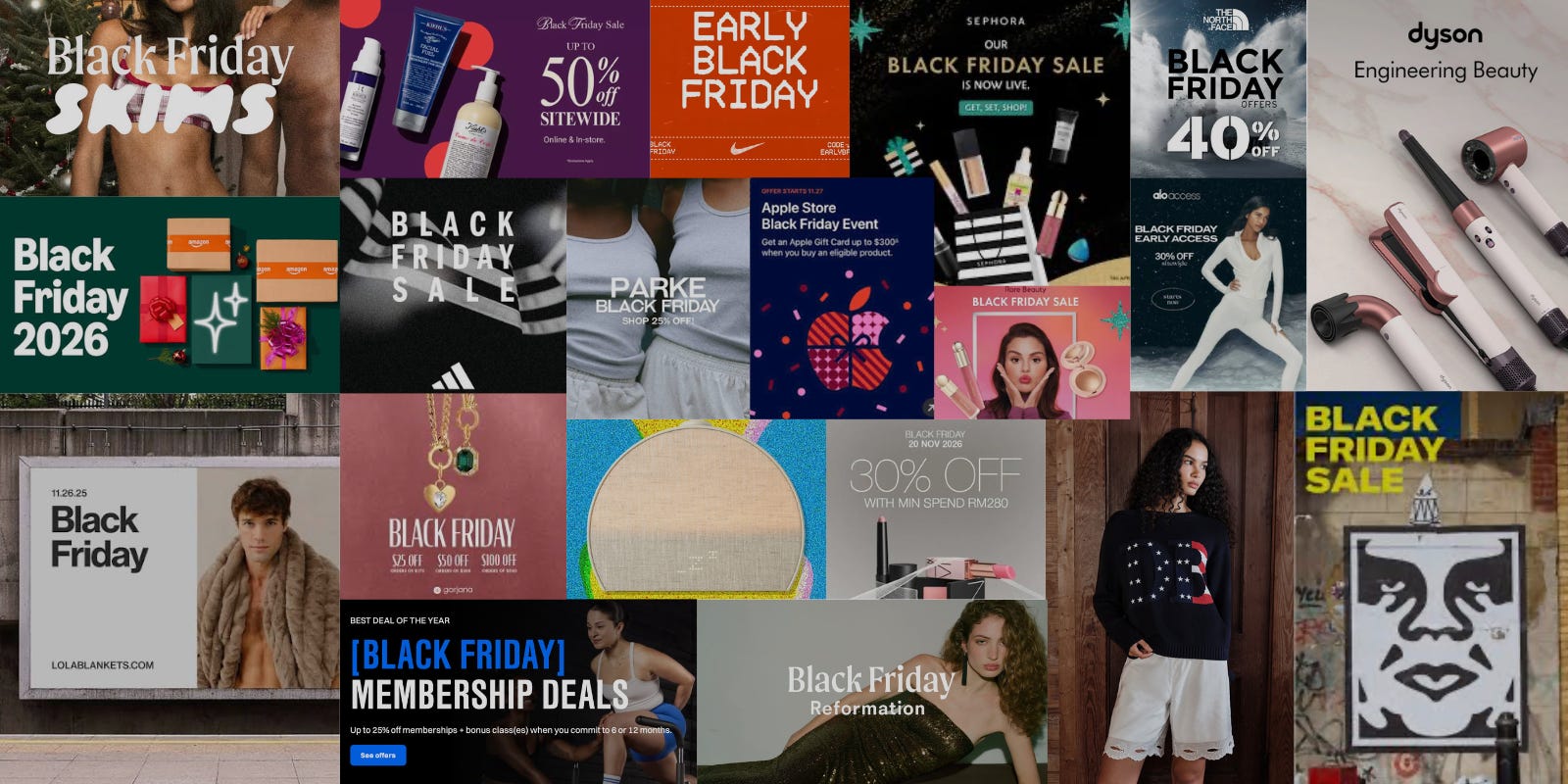
By the numbers
1 in 5 Black Friday and Cyber Monday shoppers will be Gen Z, according to a Deloitte report.
40% of Gen Z shoppers plan to use Buy Now, Pay Later programs for their sale splurges, according to the same report — making them far more likely than other generations to do so.
And they’re far more likely to shop in person on Black Friday (72% of Gen Z says they plan to shop in-person on Black Friday, compared to 50% of other generations), evidence that the IRL energy we saw over the summer is here to stay.
Read: Our piece on the rise of malls and ‘millennial culture’ earlier this year
But here’s the catch. Despite benefitting from the sales, we’re hearing an overwhelming sense of ‘sale fatigue’ amongst members of our Gen Z community.
Zooming out
Gen Z has grown up where every day is a shopping occasion i.e. influencer discount codes, TikTok Shop, Prime Day. Black Friday used to be a huge monocultural event but this generation has never really experienced scarcity when it comes to sales or consumption. It’s just part of the fabric of their digital life, which explains why they’re leaning into sales in person — which feel more novel and exciting.
According to our intern, Emilia, 2026 might be the end of Black Friday — at least in the traditional sense of the commercial holiday.
“This year, I’m opting out,” she says.
Black Friday doesn’t feel worth it anymore. Stores are constantly running sales to get people to buy, and I’m just over it. 30% off a new face mask that is always 30% off? It no longer feels like you scored big.
On top of that, I’m overwhelmed with the stuff I already have. And I’m not the only one. This holiday season, there’s no single item everyone is flocking to. There’s no new “it” water bottle or must-have pair of shoes. We did that, and now everyone has their Stanley or Owala, their Adidas Samabs or New Balances.
Don’t get me wrong. My holiday wishlist has similar categories as previous years: skincare, jewelry, clothes, but no one product is driving the season or dominating my group chats.
And it’s hard to feel the need to spend on Black Friday when economic anxiety has run rampant. The economy, i.e. money, was the biggest issue this past election, and it continues to guide how Gen Z shops. With our wallets already feeling the brunt of rent, utility bills, gas, etc. it’s hard to go chasing down another $50 hair clip or $150 pajama set that will be out of style in a few months.
— Emilia
Emilia isn’t alone. Our ambassadors shared products and brands that are breaking through with their friends. But while certain items came up over and over, there wasn’t any one item that holds the clout.
Instead, we heard more consistency in terms of spending habits. Sales are so constant that it feels like an item must be on sale to justify buying it. In other words, everything feels so expensive that sales are now the baseline. Shoppers are always waiting for the sale to buy the item with maximum utility.
As for the items that are topping their lists, the hottest items are less about luxury and more about upgrading everyday items. Skincare and wellness more still have a monopoly on young women especially, illustrating that wellness is now status. The biggest signal is no longer a bag or shoes, it’s the projection that you have everything together. In other words, there’s a sense it matters far less what you wear as long as you look cool, glowing and skinny while wearing it.
Here’s what Gen Z is shopping for
For the gals
Salomon sneakers
Dairy Boy
Rhode
Hatch alarm clock
Lola blanket
Parke
Alo
Aritzia
Emi Jay hair clips or brushes
SKIMS pjs
Roller Rabbit pjs
Cozy Land pjs
Tony Bianco or Sam Edelman ballet flats
Onitsuka Tiger tennis shoes
Oura ring
Set Active workout sets
Nike
New Balance
The Ordinary
La Roche-Posay
Target
Ulta
Barnes and Noble
For the guys
GTA 6
Legendary Whitetail flannels
Copper Moscow mule mugs
Sneakers, broadly
What they’re saying…
“I feel like for Gen Z, wish lists are a mix of things we’ve been wanting for a while, practical upgrades, and smaller luxury items that feel like a splurge but are still attainable. Beauty, fragrance, fashion, accessories, and tech seem to be big categories — things like perfume, skincare/makeup, bags, and shoes seem to be in demand, rather than necessarily one particular viral product everyone has to have. I’ve seen products from brands like Rhode a decent amount on socials lately, but I feel like I haven’t seen anything particularly trendy right now as, say, a Stanley cup in 2023.” — 20-year-old in New York City
“I don’t think Gen Z is necessarily over sales — & Black Friday and Cyber Monday are still very appealing, especially for bigger-ticket items that would otherwise be difficult to justify — but I think people are increasingly looking for discounts on things they already want, rather than buying something simply because it’s on sale. With the cost of everything always rising in America’s current economic state, I think there’s a greater emphasis on getting something you know you’ll actually use and that feels worth the money and less of a culture of overconsumption,” she said.
“I think people are generally less into sales this year. I’m not sure if it’s directly linked to the imminent or just overall fatigue from brands always having sales.” — 22-year-old in Denver
“I think the sales are redundant. Prime day I would say is still big but Black Friday deals there is a sale every other day. Also because it is online there is no rush in Black Friday shopping.” — 20-year-old in New York
“I do think with a lot of people’s money being tight just with how the economy has been doing recently, people will be taking advantage of these sales more than maybe in previous years.” — 21-year-old in North Carolina
On my radar
The Democratic National Committee announced their plans for 2028 debates (starting in June 2027) and they plan to enlist “creators and influencers.”
This comes on the heels of a revitalized and honestly quite successful midterm operation online, which Rachel Karten wrote about here: How the DNC Won the FYP. My friend Dylan Wells spoke with plenty of the content creators who could hypothetically be involved in the DNC’s 2028 plans and detailed her findings this week for The Washington Post.
My take: New media and old media both need each other for relevance in our crowded media ecosystem — and the rise of one doesn’t delegitimize the other. Plus, young Americans aren’t the only ones getting their news from content creators and individual personalities online. But the truth is that everyone is a content creator now — even candidates. The most successful 2026 candidates were the ones who translated their in-person resonance into online engagement by talking like a human, embracing vertical video, clipping in-person viral moments, and mixing old and new media. That will only intensity in 2028.
Read: An Unlikely Alliance on CNN and Jubilee teaming up for the James Talarico town hall this fall
As I said before the Talarico x CNN x Jubilee town hall, the first-of-its kind partnership was a big deal and signaled just how much Gen Z’s media habits are reshaping the industry. I expect collaborations like this to continue in 2028 — and I’m excited about it.
Want to partner with us? Email hello@theupandup.us
Noteworthy Reads
Reads: Is It Just Us? Or Was 2026 The Year Of Whimsy?, Samantha Olson for Cosmo. Gen Z Is Driving Global Political Change, Aiding Far Left and Far Right, Jim Tankersley and Amanda Taub for the New York Times. Gen Z shatters America’s political orthodoxies, Russell Contreras for Axios. When Did Everything Become a Sidequest?, Laura Pitcher for Dazed. And me, on Gen Z’s post-midterm hope, for Vox.