


Today’s youngest Americans are growing up in an environment dominated by just a few industries, all of which offer ways to supercharge human capacity with larger than life opportunities that could have big payoffs.
That was front and center at the Super Bowl, where many advertisements in coveted prime time slots went to products focused on gambling — sports betting and prediction markets — weight loss, or artificial intelligence.
Each of these tools boils down to a basic ethos: life isn’t going the way many Americans want it too right now but there are new products that can make life better, and quickly.
Let’s call it the supercharged era. AI increases productivity, gambling can make you money over night, and weight loss drugs are working magic.
The current national focus on brands like ChatGPT, Claude, Kalshi, DraftKings and Wegovy marks a stark shift away from the days when Apple, Facebook, Instagram, Uber, and Postmates dominated our attention.
If Gen Z 1.0 was raised on instant gratification, Gen Z 2.0 is being raised on the idea that you can get results even faster.
By the numbers
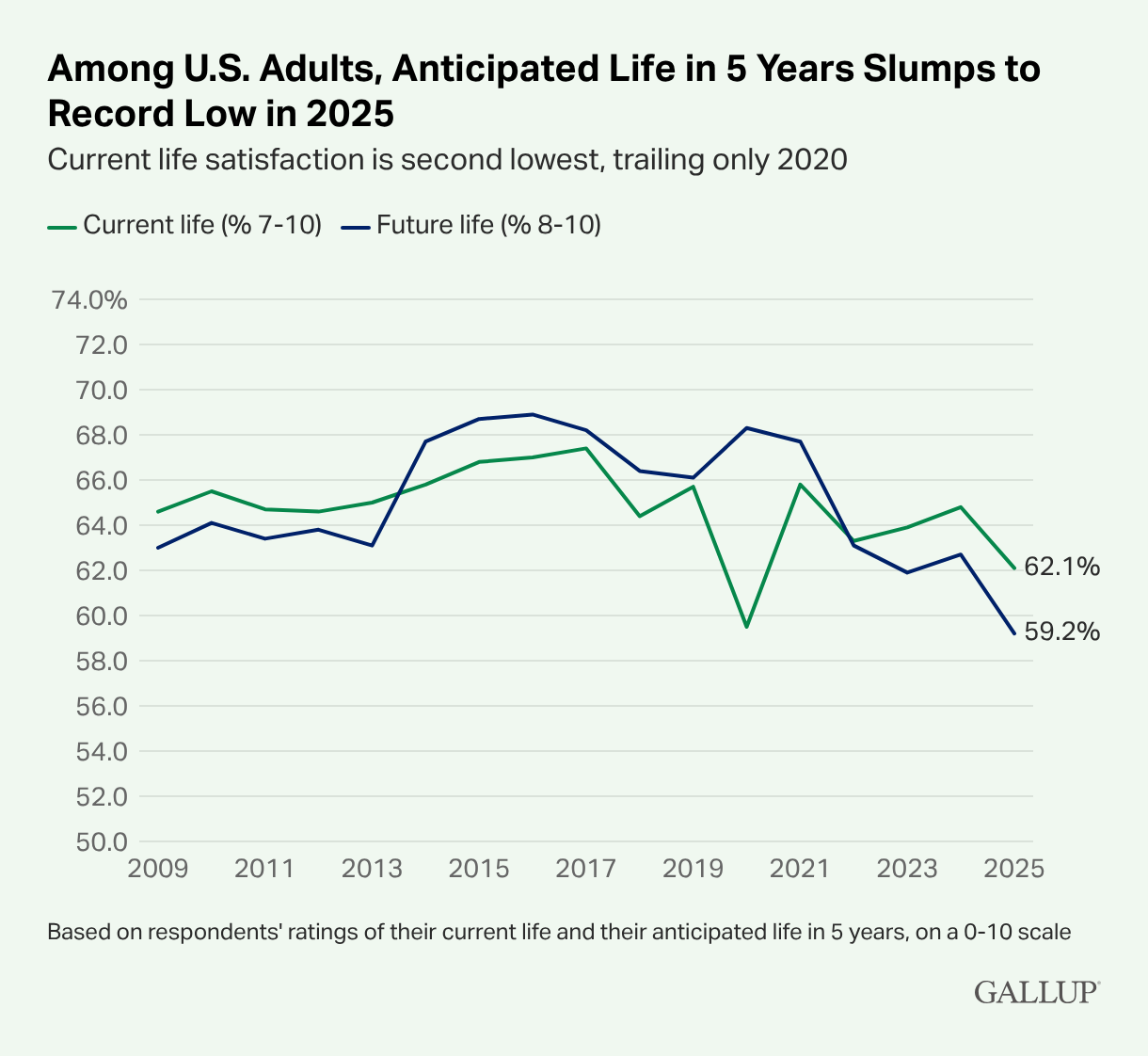
The national mood is pretty bad. In fact, American optimism has reached a new low. The portion of Americans who say their life could improve in the next five years is now at 59.2%, a stark 9.1 points lower than the pre-2020 rate, according to Gallup data released today. When it comes to young Americans, they’re surviving — not thriving. More than half of young adults (57%) are struggling, according to a Gallup Walton Family Foundation study from August.
Young people are financially frustrated. Meanwhile, almost half of young adults (43%) are having a hard time financially, according to a Harvard IOP poll from last fall.
Comparison culture is crippling. Gen Z is constantly comparing themselves to others. Nearly one third (27%) of US teens said the content they see on social media makes them feel worse about their own lives, according to a Pew Research Center study from last year. When your friends post about how the latest AI-hack has changed their life or thirst traps from a luxurious trip abroad, there’s a pressure to keep up.
The Up and Up’s take: Social stress matters. There’s skepticism around today’s newest technologies. But when it feels like everyone else is using them, and you aren’t, you start to feel behind. It’s a 2026 flavor of FOMO.
I’m thinking back to a listening session I held in Arkansas last spring. A college junior, applying for summer internships, regretted not using AI during her interview process because she assumed everyone else competing for the same spot did. Her decision, to stick to her gut and do things the traditional way, didn’t ultimately improve her chances at success. And at the end of day, it took longer.
An update
Exciting news! I am joining The Bulwark as a contributor, diving into all things Gen Z. Last week, I joined Sarah Longwell on The Focus Group podcast to discuss how young Trump voters feel about 2026, foreign policy, and dating. You can watch the full episode here, stay tuned for more.
Noteworthy reads
MrBeast’s company buys Gen Z-focused fintech app Step, Amanda Siberling for TechCrunch
The vanishing 16-year-old driver, Julia Pugachevsky for Business Insider
The Program That’s Turning Schools Around, Annie Lowry for The Atlantic
Students Are Skipping the Hardest Part of Growing Up, Clay Shirky for The New York Times
Congrats on joining the Bulwark!