

Today’s edition of The Up and Up is sponsored by the Pew-Knight Initiative, which supports research into the modern news and information environment conducted by Pew Research Center with funding from The Pew Charitable Trusts and the John S. and James L. Knight Foundation.
Gen Z is shaping what comes next across industries and because everything is changing so fast, they’re the first generation forced to adapt in real time. And nowhere is that more obvious than the way they consume news.
Here’s the paradox: Gen Z is jaded and less trusting than their parents and grandparents, but that doesn’t mean young people are not engaged. If anything, it means they’re more selective about who they listen to, and quicker to clock when something feels off. They’ll pay attention when something feels relevant and specific, but they’ll tune out quickly if something feels like spin.
And while Gen Z’s news consumption habits are unique, they’re not entirely unpredictable. That’s partly because there aren’t gatekeepers the way there used to be. The line between news and entertainment has become blurred — as has the one between journalist and content creator. In that world, the individuals and outlets earning trust look different than ever before.
Gen Z is not monolithic — but young Americans’ news consumption habits aren’t random either. There are a few consistent truths about how our generation consumes news that shape how we watch current events in-real-time, make sense of global affairs, and, in turn, decide what’s worth taking seriously.
At the end of last year, Pew Research Center released an analysis on ‘Young Adults and the Future of News’ from the Pew-Knight Initiative, breaking down how young adults ages 18-29 consume news.
Beyond showing that young news consumers are more reliant on social media platforms (like TikTok, YouTube, and Instagram) than news sites, podcasts, and email newsletters, the analysis underscores something deeper — we don’t just get news differently, we relate to news and newsmakers differently than our parents and grandparents did.
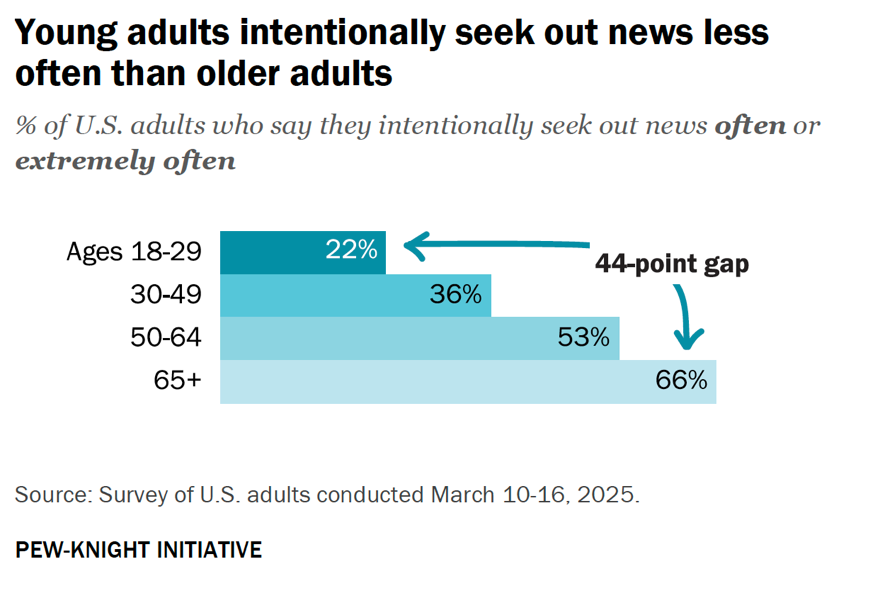
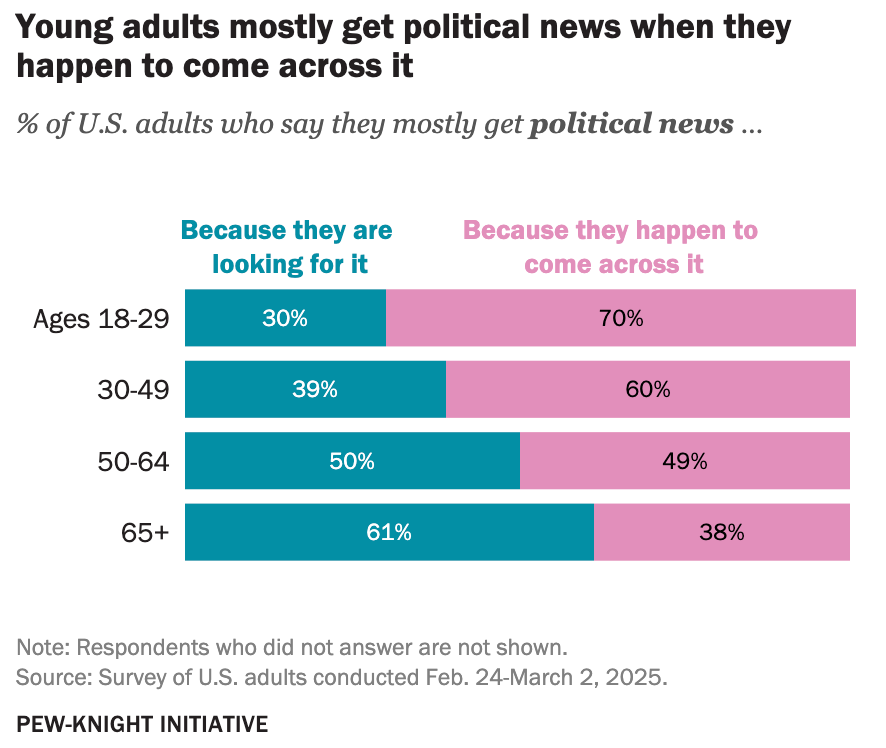
Pew’s analysis found that young adults are:
Less active news consumers
More flexible about who “counts” as a journalist
And, as a result, redefining what the job even is
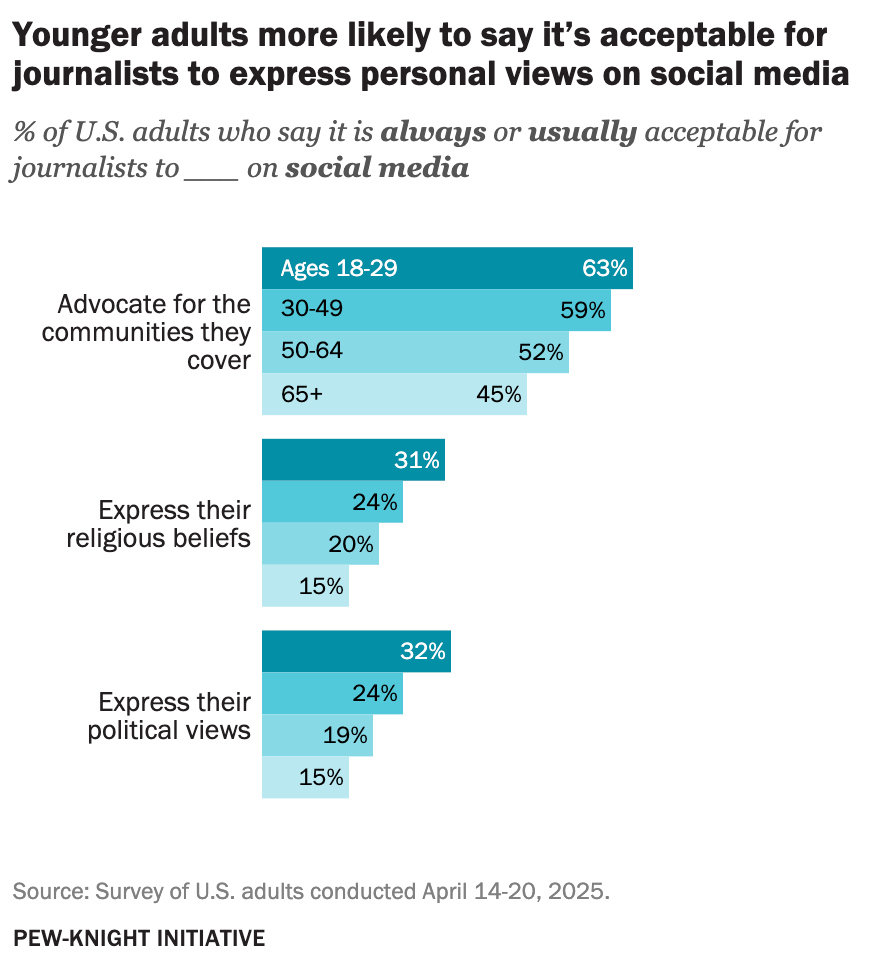
Journalists have historically been expected to stay neutral. But young adults are more comfortable with journalists showing where they’re coming from, particularly on social media.
63% of 18-29-year-olds say it’s acceptable for journalists to “advocate for the communities they cover” on social media
31% say it’s acceptable for journalists to “express their religious beliefs” in these online spaces
And 32% say it’s acceptable for journalists to “express their political views”
To complement those findings, I spoke with members of The Up and Up’s Gen Z community about what actually earns their attention.
In a January listening session with a dozen Gen Zers ages 18-26 from seven states and Washington, D.C., the group shared that while they rely heavily on social media for news and information, algorithms can take a meaningful toll on their mental health and up the ante on political partisanship. And what they see online often translates to real life. We spent a good chunk of time discussing debate-style videos, made popular by leaders like the late Charlie Kirk or platforms like Jubilee.
Here’s what we heard.
YouTube’s prominence cannot be overstated. Participants emphasized the role YouTube plays in their media diet — often serving as background noise to the sounds of everyday life. To our community members, YouTube feels more like Netflix, a platform to stream news content, often under the guise of entertainment.
For one 22-year-old woman from Ohio, YouTube feels like a controlled “detox from doomscrolling.” She often forces herself to sit down and watch long-form content to train herself that she can handle it, rather than relying solely on short-form content.
Algorithms often reflect short-term fixations > long-term interests. Look something up once and you’ll get videos of it for days. That’s the general sense of how the young adults I spoke with feel their algorithm works. Which means that when a global event is happening and trending online, it feels like everyone is talking about it 24/7, but it really may only be 24/1, for one day (or even a few).
That same 22-year-old from Ohio said that her TikTok algorithm moves so fast that she feels like a “different person hour to hour.”
Meanwhile, an 18-year-old from Arizona said his algorithm feels “scarily accurate.” But he’s noticing more and more “rage bait” or engagement-bait content that lacks substance or real nuanced arguments.
One thing older adults are getting wrong: Gen Z news consumers are more discerning than they’re given credit for.
“Some of the stereotypes that the older generations label us with, I think we are aware of it. That we’re scrolling all the time, that we have a hard time focusing, but that is unfortunately part of the world we grew up with and we have been exposed to both the good sides of it and the negative of it. We are aware of the downsides of it and are trying to actively prevent ourselves from being exposed to the more negative sides of social media,” said a 22-year-old from Massachusetts.
Others say they feel like their friends know that they’re watching junk, but decide to watch it regardless, for the bit.
A 19-year-old young man from New York said that older generations don’t understand the “metacognition” of Gen Z news consumers, who know that some content is “brain rot” or “dumb” but choose to watch anyway, often ironically.
And there’s outdated conventional wisdom that social media has turned Gen Z “woke.” According to our listening session, that’s not the case.
“That’s certainly not what has made this generation woke. We have grown up with so many world-changing political situations. Most of us were probably really young around the time of the housing crisis and stock market crash of 2008, we went through Covid, we’ve gone through police brutality and George Floyd, we’ve gone through so many social movements that I think have influenced our political opinions. And maybe access to media has made us more informed on those topics, we know about it more than maybe generations before us may have. But it’s the political climate we’re in that has made us woke,” said a 22-year-old from D.C.
The Up and Up’s analysis: Reading between the lines of the Pew-Knight Initiative data and my own, a few things are clear.
Gen Z news consumers know that no one is unbiased. Everyone (even journalists), brings their personal experience to their work, and as a result, young adults’ respect it when (and have even grown to expect) journalists are upfront about how they’re coming to a story.
Transparency is key. This is true of Gen Z consumers across industries. They want to see how the sausage is made — or they won’t trust it. Gen Z news consumers will reward creators who are willing to show how they got to a story, and what was left on the cutting room floor. There’s a way to do so while maintaining sources’ trust.
Nuance may not immediately go viral, but it’s driving long-term engagement. Everyone’s sick of rage-bait or over-simplified headlines that reduce a story to its bones, taking out any real character or contradiction. Instead, they’re looking for stories that go a bit deeper, offering a new perspective or bringing friction to a preconceived notion.
I wonder if you're elevating "journalism" - the process of reporting - over "news" - the actual events that journalists cover.
Since, the internet gives you direct access to the news, how important is "journalism" in reality?