

One of the most telling questions I’ve asked in recent listening sessions is: “What do you see as the biggest generational divide?” It’s a good way to analyze rifts between gen z and our parents and grandparents.
Earlier this week, when asked that question, a 19-year-old told me he views the biggest divide as support for “vigilante justice” or “to just burn it all down.”
More on that below…
His hot take was quickly followed by two timely polls – both showing that a notable slice of young Americans accept some form of political violence.
Today, the Harvard Institute of Politics released its bi-annual youth poll, in which 39% of Americans ages 18-29 showed “some acceptance” of political violence.
And just yesterday, a poll from Gallup and the Kettering Foundation showed that 30% of 18-29-year-olds said political violence is “sometimes OK,” the highest portion of any age group to condone it.
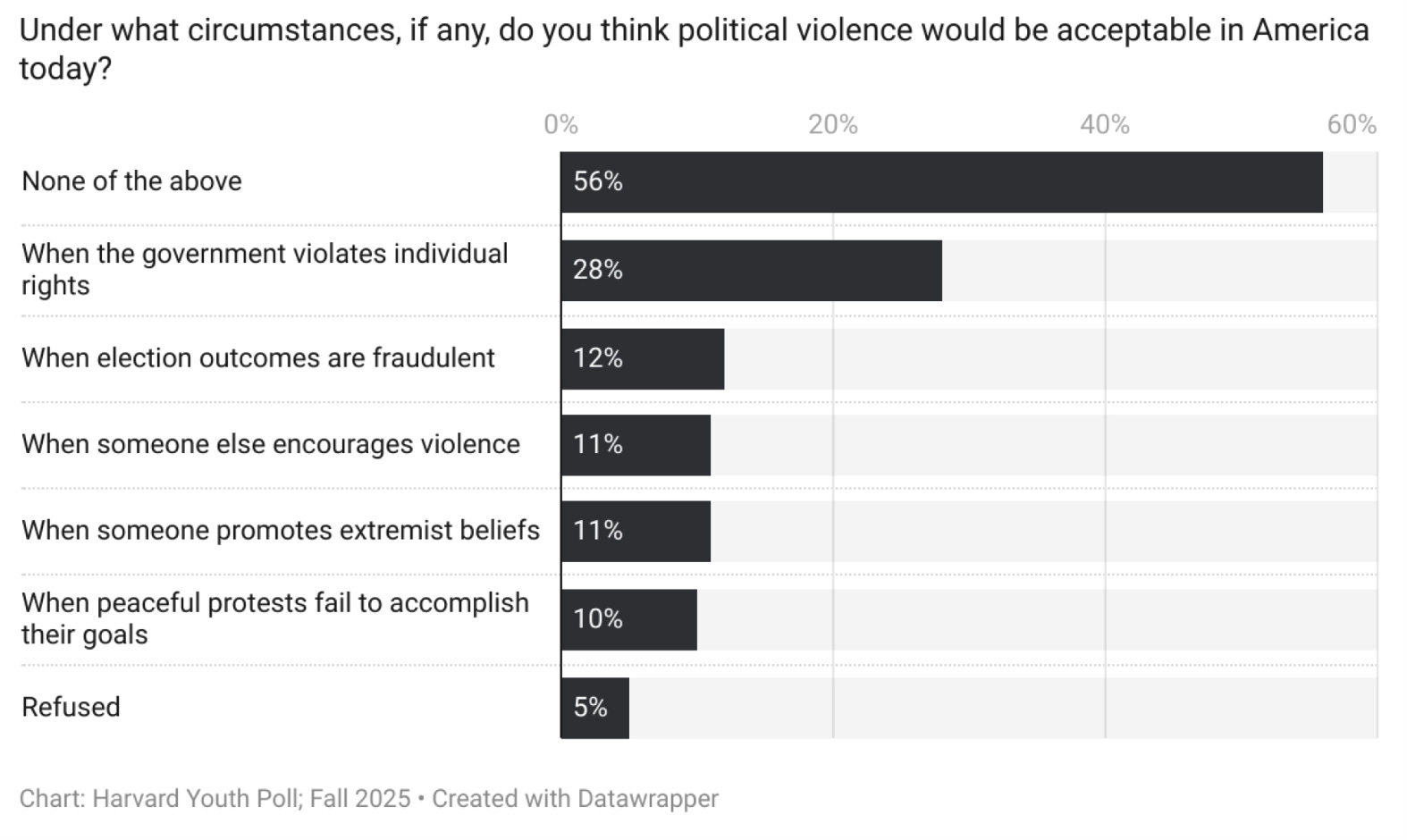
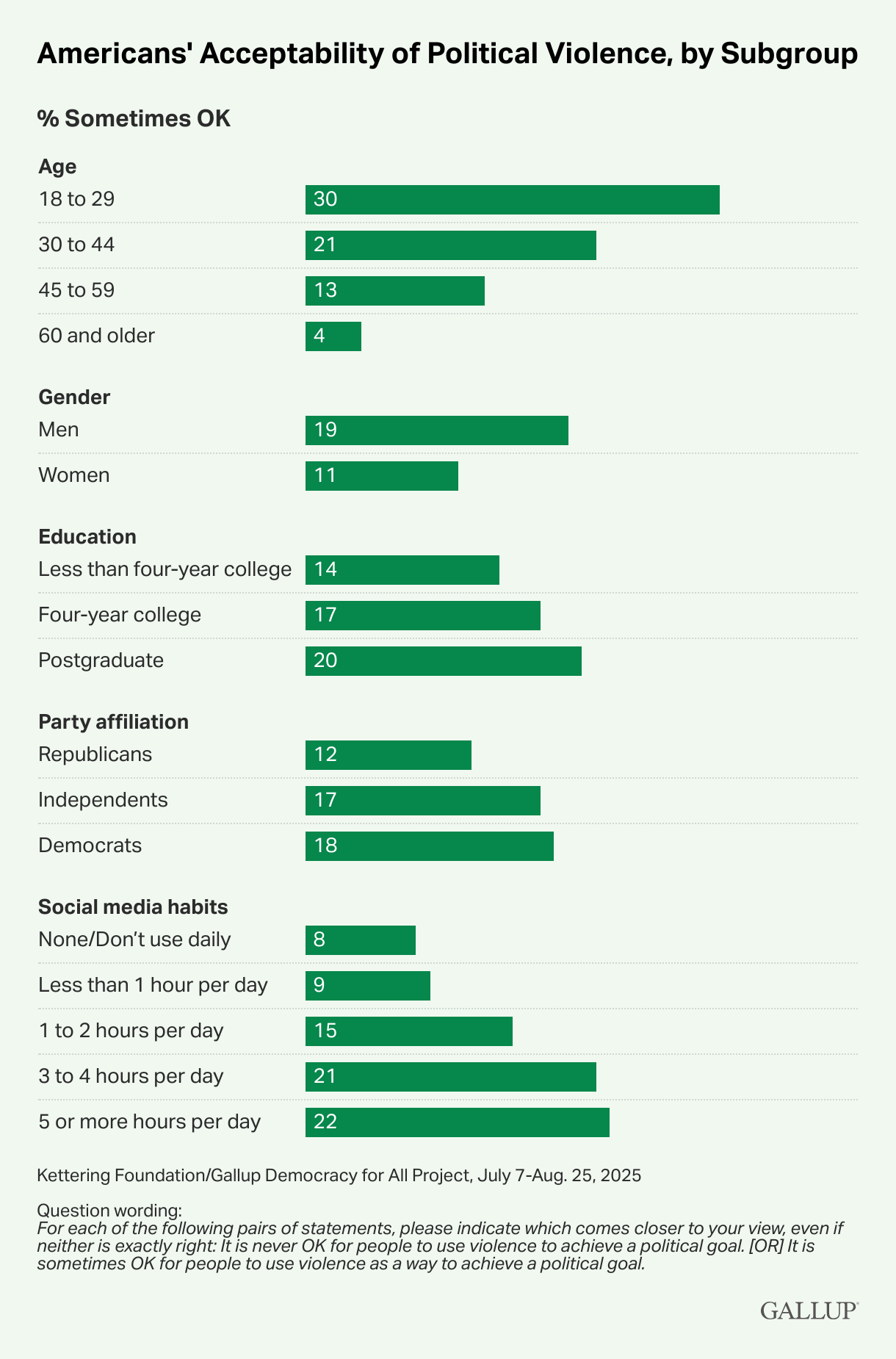
More details: While the Gallup/Kettering Foundation poll showed a relationship between loneliness, gender, and acceptance of political violence, in the IOP poll, predictors of one’s willingness to accept violence were fueled more by “financial strain, institutional distrust, and social alienation.”
According to Gallup and Kettering, “45% of men aged 18 to 29 who ‘always’ or ‘often’ feel lonely say political violence is sometimes acceptable,” which is higher than other “relevant groups.”
According to the IOP, “most reject political violence outright, but a meaningful minority sees specific situations in which it may be justified — and those views are shaped more by instability and strain than by ideology alone.”
Let’s rewind. Exactly one year ago, United Healthcare CEO Brian Thompson was assassinated in New York City. Over the summer, Minnesota state Rep. Melissa Hortman was assassinated (along with her husband) in her own home. And in September, Charlie Kirk was assassinated while speaking at Utah Valley University.
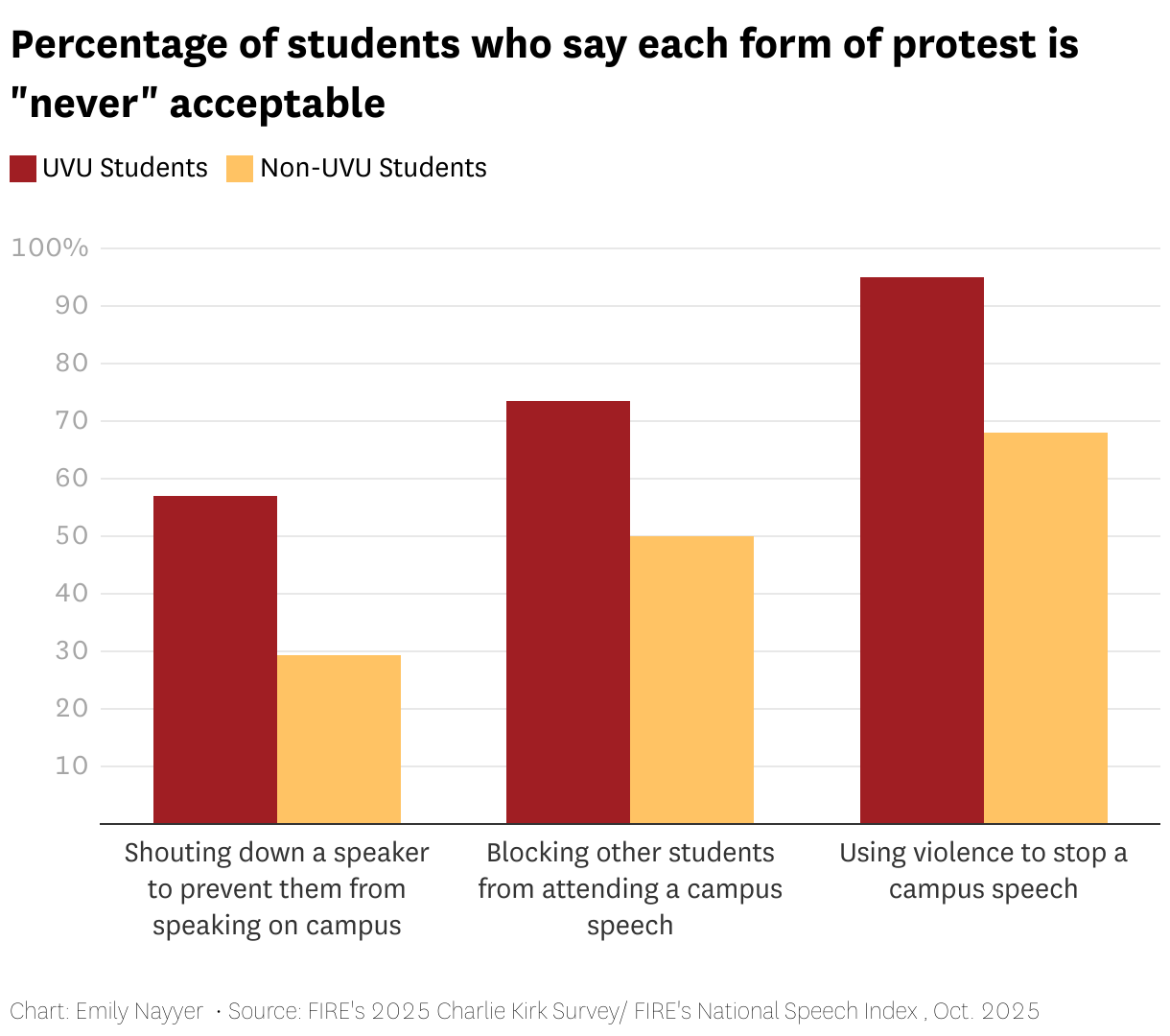
In a third poll from the Foundation on Individual Rights and Expressions and College Pulse this week that includes an over sample at Utah Valley University specifically, a majority (53%) identified political violence as a problem. Meanwhile, 68% of all students said using violence to stop a campus speech is “never” acceptable. At UVU, the site of Kirk’s assassination, 95% of students said the same.
A chilling way to grow up
Political violence is part of our current national reality — and that’s a chilling way to grow up. What’s even more alarming, in both hard data and my conversations with young Americans, is what feels like a generational divide — in some places more than others — in a willingness to condone it.
Gen z, which was previously seen as an exceptionally empathetic group of young people, seems to be bleeding compassion.
From the outset of our listening sessions with members of The Up and Up community this week, it was clear that violence is woven into how young people are experiencing politics today.
This culture will inspire some to want to heal our broken political climate. For others, it will likely radicalize them further. And a third group is at risk of tuning out altogether, desensitized to it all and sanitizing themselves of any political discussion as a result.
Here’s more of what I heard in our sessions, and what to make of it.
🔑 What You’ll Unlock: Highlights from this edition
How gen zers describe the current state of U.S. politics
Our compassion recession
Three ideas for improvement
