

Judging by headlines and cable news hits, it’s been a socialist summer. But the recent obsession on Gen Z’s flirtation with socialism is missing the mark.
Yes, democratic socialists have racked up electoral victories in primaries in New York, Colorado, and New Jersey, and recent polling suggests that Gen Z has a more favorable view of socialism than older generations — and prefers socialism to capitalism. By the numbers: A Cato Institute poll ahead of America’s 250th found that more than half of Gen Z supports socialism (53%) compared to the 45% who support capitalism.
But I’ve been asking the young people in our summer focus groups to define socialism, and there’s not a real consensus on what it actually means.
Beyond that, I’ve yet to have a focus group participant tell me they’re a full-throttle democratic socialist (even if they like the policies they say democratic socialists are proposing). So assuming that all young voters are well-versed in socialism and embracing the ideology outright is false.
Most recently, I asked a focus group of left-leaning young voters between the ages of 19 and 33 what socialism means to them. While all eight participants said they had heard of it, only one defined it head on.
“Democratic socialism is obviously a subsect of socialism which in itself is a theory that promotes the involvement of the state in public welfare,” said a 21-year-old from Miami, Florida. “Especially coming from a Hispanic background myself, you hear a lot about socialism being thrown around as something equivalent to like the devil. It’s the child of communism in a lot of Latin people’s brains and it’s something that, to them, has destroyed countries. You look at other cases of democratic socialism, you see that Norwegian countries tend to implement it quite well. And then also the US has a lot of cases of democratic socialism like [what] Zohran Mandani is doing for example or is vying to do welfare like healthcare, education, all of these things kind of encompass that and so I think it’s up to perception.”
“To me, it is different now than it was in 2020,” said a 27-year-old from Northern Virginia.
I asked the group to share policies that come to mind when they think of democratic socialism. It’s becoming more and more clear that many progressive ideas that were central to the 2020 Democratic primary (like paid family leave and universal healthcare), are now broadly coded as socialist — and these are policies that young liberals widely embrace.
Here’s what some shared.
“Universal healthcare,” said a 21-year-old from Boston, Massachusetts. “That’s just the first thing that comes to mind, is the government’s involvement in making sure that everybody is cared for and everyone’s health remains a priority despite their income. And I think that is something that makes me view socialism in more of a positive light because some people obviously don’t have the same financial situations as others. That doesn’t mean that they should be undervalued in society.”
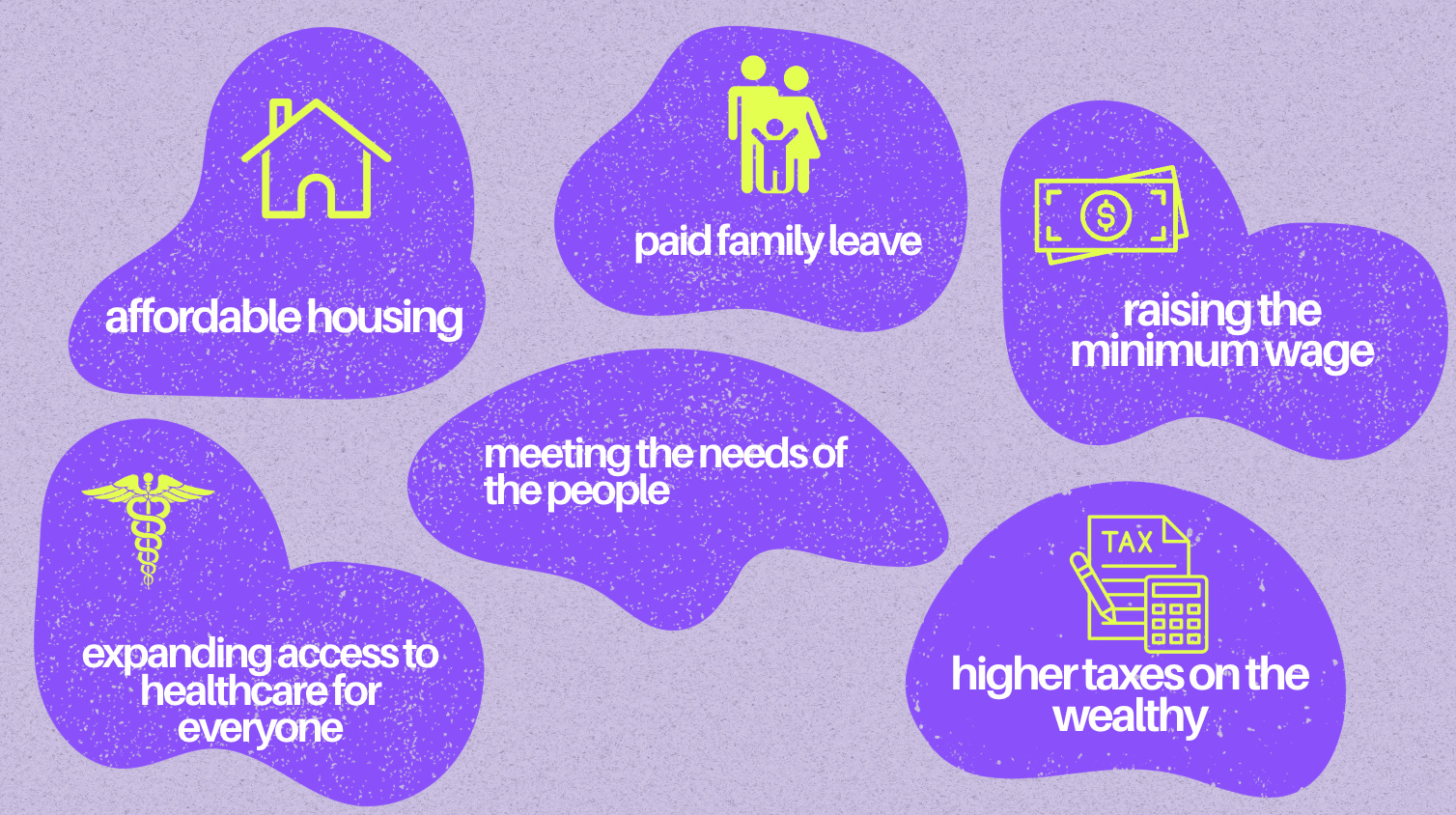
“When I think of democratic socialists, they’re trying to meet the needs of the people,” said a 23-year-old from Arizona. “Expanding access to healthcare. Making college or education more affordable. Raising the minimum wage. Investing in affordable housing. Expanding programs like paid family leave or for child care. And I think I also associate it with higher taxes on wealthier individuals or large corporations to help fund those kinds of public services.”
Asked to name candidates or politicians that are doing a good job right now, it’s obvious that DSA candidates are rising. But that’s not the full story.
Participants listed New York City Mayor Zohran Mamdani, Rep. Alexandria Ocasio Cortez, and Melat Kiros — the DSA candidate in Colorado who’s likely to become the first Gen Z woman in Congress. But they also named Senators Jon Ossoff and Mark Kelly.
When I asked the group if they’d label themselves a democratic socialist or socialist, not one person raised their hand (at risk of sounding like a broken record, Gen Z hates labels). But some are starting to “lean” that way — and that matters.
“I would say I lean towards it, but I haven’t completely been with that party,” said a 19-year-old from Colorado.
“I would say I’m in between democrat and democratic socialist,” said the 23-year-old from Arizona.
“I would definitely lean that way,” said the 21-year-old from Boston.
So what?
As the 2026 midterm elections come into focus, our research demonstrates that young liberals are still wary of outright embracing “socialism,” even as many support policies that increasingly read that way. Politicians who loudly advocate for bold, progressive policies will continue to capture attention and relevance, while those without a clear vision or an ability to articulate what they stand for will fall by the wayside — regardless of their party affiliation. And when it comes to Democrats, if traditional (i.e. establishment) candidates continue to cede ground by failing to illustrate what the America they want to live in actually looks like, they’ll continue to lose — not just in the 2026 midterms, but in gaining this generation’s loyalty.
Noteworthy reads
Relatedly, this piece from the WSJ’s Future View titled ‘Socialism and the Young’ offers a great analysis from a number of young adults
Gen Z Fell Out of Love With Work. I Don’t Blame Them., Emi Nietfeld for The New York Times
Call Her Mommy. Gen Z women are paying for, and parenting, their boyfriends., Angelina Chapin for The Cut
Young Adults are Letting AI Do Their Talking for Them – Even In Person, Natalie Kaufman for The Wall Street Journal
You do such great work on Gen Z! Thank you!