

Hear me out. Gen Z has an unlikely hero: Pope Leo.
He plays Wordle, loves the Sound of Music, told young people they should be called Gen+ because of what they will contribute to the world. And now, after his official speech on AI, he seems to be speaking to this generation’s fears and frustrations more directly than almost anyone else in power.
At a moment when nearly every institution feels either performative, profit-driven, or absent entirely, *the pope* is offering something young people feel starved for: moral leadership.
In his Monday encyclical Magnifica Humanitas, Pope Leo addressed AI with a level of clarity and nuance that feels notably absent from most political leaders (cough Trump, cough) and even many tech execs themselves.
As Gen Z’s AI anxiety reaches new heights, the pope confronted the issue head on, not with blind optimism or apocalyptic fear mongering, but instead, with a vision centered on humanity.
That matters because Gen Z is the last generation to truly straddle life pre and post-AI, to try to build identities in a world increasingly mediated by algorithms, and left the most vulnerable to its disruption.
Lots of people talk about AI, but not all sound human doing it. Pope Leo toed that line.
READ A CHORUS OF GRADUATION BOOS
Here are the top reasons why:
What makes his message resonate is that he’s one of the few people discussing AI who does not appear personally invested in the race to profit from it. This is rare. Young people are deeply skeptical of institutions right now. Especially when those institutions stand to financially benefit from the very disruption they’re promising will augment human potential. The pope, by contrast, feels outside of that system and laser-focused on centering human interest over corporate interest.
There was empathy, compassion, and humility in his words. It feels like he’s looking out for his community, for humankind. His speech didn’t sound like it was written by AI. He also acknowledges that he is not offering a “comprehensive treatment of artificial intelligence” and is real about his own capability. That kind of honesty stands out at a time when so many leaders insist they are certain about the technologies they barely seem to understand themselves.
This is the most human a leader has sounded in a while. For years, much of the public conversation around AI has revolved around productivity, efficiency, optimization, and scale. The pope instead focused on dignity, meaning, labor, truth, and human connection, which are the exact things many young people fear are being eroded fastest by algorithms.
His take was notably nuanced. He didn’t reject AI (far from it… in fact Anthropic exec Christopher Olah was there for the speech). Instead of saying AI is inherently good or evil, the pope argued that innovation should be judged by whether it expands our collective potential and ability to flourish — not replace human purpose. That distinction is important, and it’s one a lot of young people are desperate to hear articulated clearly. Gen Z is exhausted by black and white thinking; they get enough of that on social media. They don’t want leaders who pretend AI will either save civilization or destroy it overnight. They want someone willing to be honest about both the promises and the tradeoffs.
The pope also did something few leaders currently do, calling out the question of who should be held responsible. Pope Leo directly challenged the people building it to take seriously its social consequences instead of just assuming it’s an unstoppable force of nature (Spoiler: it’s not. Its future is being decided by a select few who hold power in tech and politics, and Gen Z knows that). The pope is focusing on areas (truth, education, labor, purpose) where many young people increasingly feel institutions have stopped short of protecting them altogether. He’s calling for accountability, safeguards, and ethical standards.
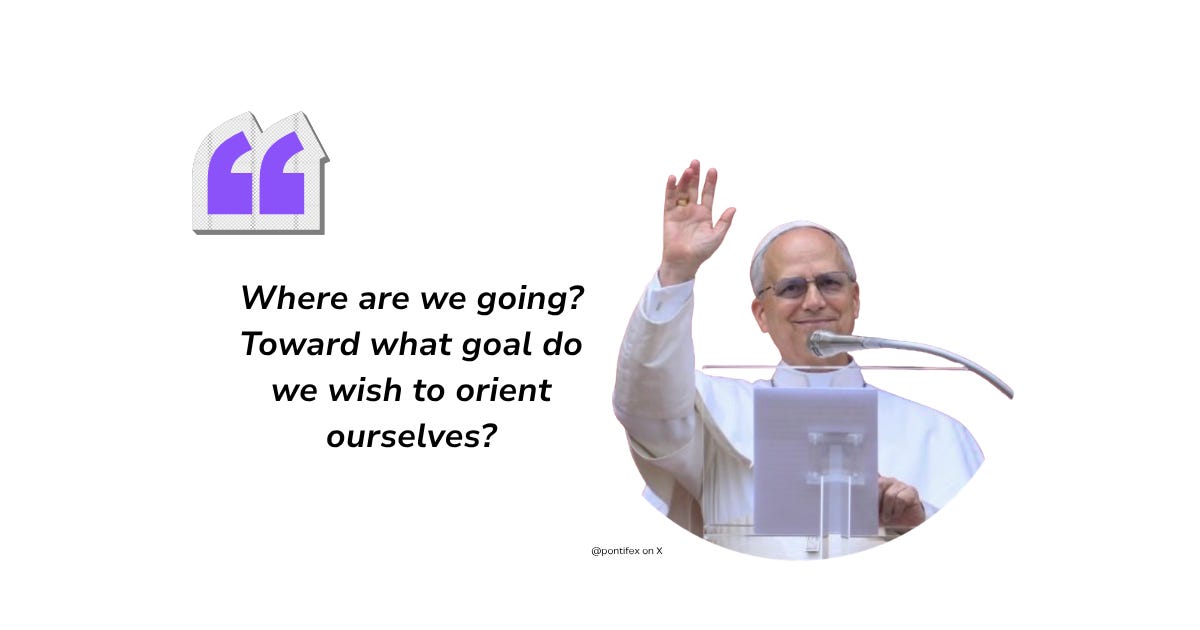
He’s also asking the bigger-picture questions, which are at the core of Gen Z’s AI anxiety: “Where are we going? Toward what goal do we wish to orient ourselves? What direction should we choose as a people and as a human community?”
His honesty about the situation (that AI marks a tuning point for civilization) wasn’t just lofty rhetoric or something for a quick soundbite. It was rooted in history, data, and recommendations. One of the biggest complaints I hear from young adults is that leaders (in politics, education, the workplace) often talk about a problem without offering a clear solution. There was research that went into the pope’s encyclical, including evidence on the impact of tech on kids, teens, and young adults.
Noteworthy reads
Gen Z’s preparedness paradox, my latest with Lori Cashman for The Boston Globe
Tinder is betting Gen Z daters would rather be offline, Samantha Kelly for Bloomberg
Is it just us? Or is everyone wearing swimwear as streetwear?, Jessica Neises for Cosmopolitan
Gen Z is turning to gig apps like Uber or GoPuff for summer jobs, Alex Bitter for Business Insider
Terrific post! You nailed it!
Great piece, Rachel!