


The world’s changing before our eyes, and yet, for the most part, K-12 education has stayed the same. What that means for Gen Z is that while the rules of the proverbial game of life have evolved (thanks, in part, to their dedication to rewriting them), the training for adulthood hasn’t kept up, leaving the conventional K-12 education somewhat at odds with our current macroeconomic reality.
The result is that — according to new data from Gallup and The Walton Family Foundation’s ‘Voices of Gen Z’ Study — the current classroom experience is not meeting the moment.
Tl;dr: The K-12 experience would benefit from creativity.
Earlier this summer, in partnership with Gallup and The Walton Family Foundation, I convened focus groups with current high school students and recent high school grads. The focus groups piggyback Gallup and The Walton Family foundation’s new data showing that — despite some bright spots in K-12 education over the past decade — many students feel unprepared for their futures and are itching for innovation in what traditional “school” looks like.
It’s well-past time to think big about the role that school can and should play in young adults’ lives. There are bright spots of career-connected and experiential learning programs already leading the charge — those should be replicated.
By the numbers
According to the latest data:
Less than half of Gen Z K-12 students “enjoy going to school every day” (just 11%) or “most days” (37%)
40% of Gen Z K-12 students do not feel prepared for their future (that share jumps 10 points to 50% amongst students who don’t plan to go to college)
One third of students (33%) don’t feel like they belong at school
Nearly half of Gen Z K-12 students (49%) don’t think school gives them the chance to “do what they do best every day” (a 14-point drop since 2023)
Less than 20% of students say an adult has talked to them about “postsecondary options other than college”
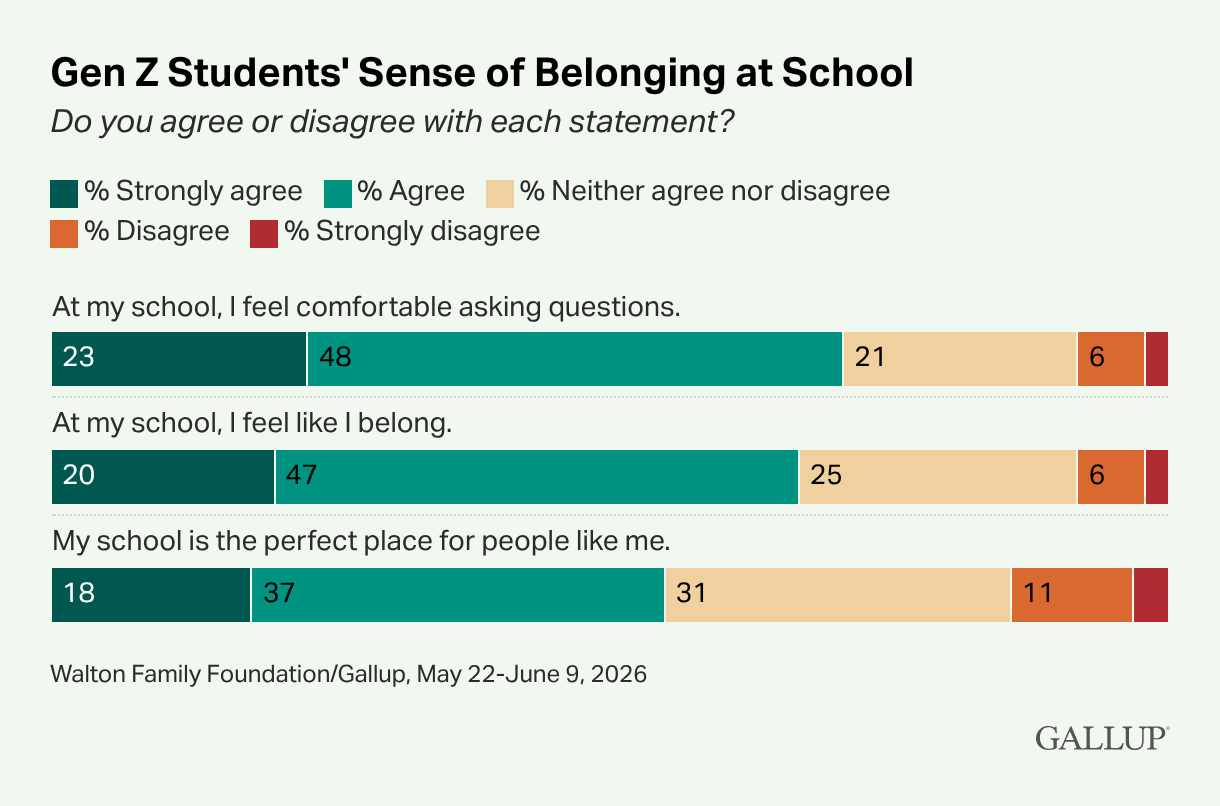
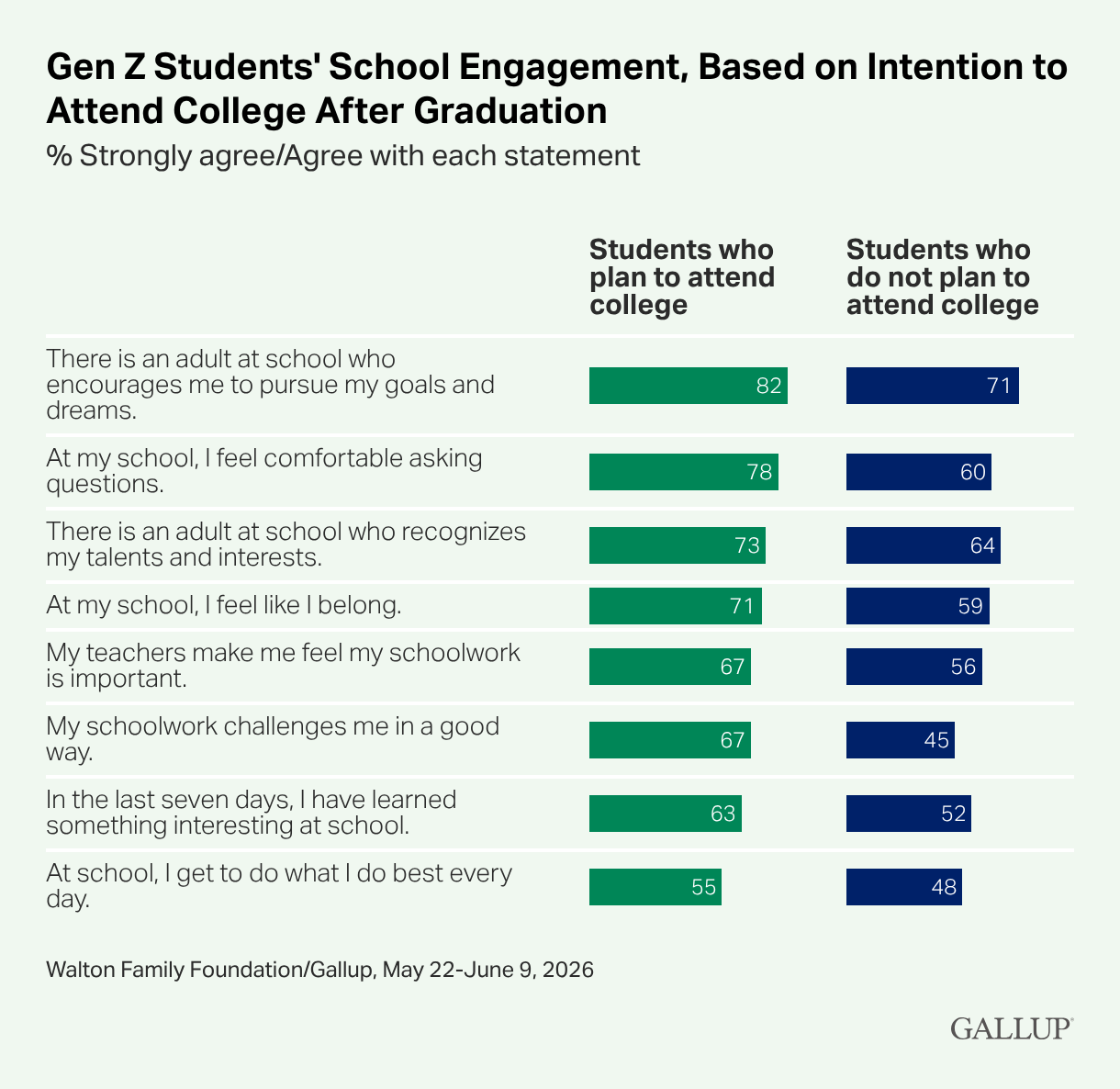
Those with a bone to pick with *kids these days* may read these stats and say, ‘Ok, this has always been the case, school’s always been boring, and Gen Z doesn’t have it much different than anyone else.’ But think about how much has changed in the past six years alone, post-Covid and now with AI, and the massive paradigm shifts in the workplace (and really just life) as a result. Last I checked, the purpose of school is, in fact, to prepare kids for their futures, so shouldn’t we try to meet that goal?
As the function of work begins to look different and interpersonal skills become even more critical to success, schools need to — at least — arm students with confidence to thrive in the rest of their lives.
Right now, that’s not how they’re feeling. But they’re pretty blunt in explaining how to bridge those gaps.
Students may never feel “ready,” but they can feel prepared.
In short:
Teachers and 1:1 connections with adults matter.
Extracurriculars should be embraced, but often aren’t. Same goes for career-connected or experiential learning.
As the ROI of a traditional college degree becomes more of a question, pathways other than those that involve a traditional college campus experience need to be supported by teachers and parents.
And for a generation of late bloomers coming out the other side of an isolated, way-too-online childhood, human-to-human, social skills should be prioritized.
Here are some of their first-hand perspectives.
“The structure of high school wasn’t very helpful to where I am now. I don’t really think most of my classes that I took in high school I have in my brain anymore. Like, I just don’t. But I would say certain people, specific teachers ... genuinely made an impact, and I still am able to go to them,” said a 20-year-old female from New York.
“I wish that the school environment was more accepting of extracurriculars, because I think sometimes engaging in a club or an activity that you actually care about can feel like a punishment because it can set you back and give you less time for schoolwork. And I think teachers don’t really address that,” said a 17-year-old female from Pennsylvania.
“I feel like in my high school, there wasn’t really a lot of pushing from the school or the teachers to try to get you [to] go out there and experience a lot of things. A lot of the kids that were more successful coming out of high school kind of had to do those things on their own and kind of had to find programs or places to go to that would really suit their interests. There wasn’t really a lot of that available, at least in my school. So, I feel like if there was a more widespread focus on that, that would be extremely beneficial,” said a 19-year-old male from Ohio.
“Everyone wants to do different stuff when they’re older. I wish some schools could maybe have different types of classes that could benefit a wider range of people than just, like, your ordinary math, science and histories and stuff like that,” said a 15-year-old male from Massachusetts.
“I think maybe it has to do with post-pandemic and everything, but people in school nowadays are kind of lacking social skills and sometimes, not all the time, but sometimes lack the tools to be able to just relate with each other. And I’ve been in a lot of situations where in the beginning of the year, the teacher will say, ‘Hey, don’t worry. We’re going to do a lot of hands-on work, a lot of talking-to-peer work,’ and it just devolves into paper packets and busy work,” said a 17-year-old male from Arizona.
“When most adults talk about the future, the first thing they think is going to college and getting a degree. ... At least at my school, I also feel like when people mention like, ‘Oh I want to go to like the Marines or the Army or the military when I’m older,’ or if they want to go to a trade school or do something of that sort, I feel like sometimes teachers get a little bit self-defensive of college. ... I feel like there should be more representation that teachers show to other career paths. ... If I heard of other paths after high school, like trade and stuff like that when I was younger, I feel like what would have been my interest would have changed,” said a 15-year-old male from Massachusetts.
This survey data comes alongside the ongoing ‘Voices of Gen Z’ Study with Gallup and the Walton Family Foundation. Data from this series has been crucial for making sense of Gen Z’s AI anxiety, how they feel about their futures and present, especially when it comes to school and work, and shed light on Gen Z’s rightward shift well before the 2024 election. The Walton Family Foundation has also supported my work on these topics.
Yes so good. Great way of putting it.
I have been saying this for the last six years/seven years. I worked in a high school and I have three kids, just finishing college. My kids were lucky enough to know college was the place for them. I’ve seen so many at the high school and of their friends and peers that college was not gonna be a good fit for them. Just like the lockdown for Covid showed there were some kids that actually worked well under those condition conditions, and others just did not. We spent too many years, teaching to the test and not educating our children for their future.