


If there’s one thing I’ve learned from spending so much time talking to young voters, it’s that their frustration with politics doesn’t fit neatly into either party’s narrative.
Ahead of the 2024 election, when much of the conventional wisdom was that Gen Z was overwhelmingly progressive, I warned that young voters were far more politically unpredictable than people assumed. And the election proved just how much we’d underestimated that.
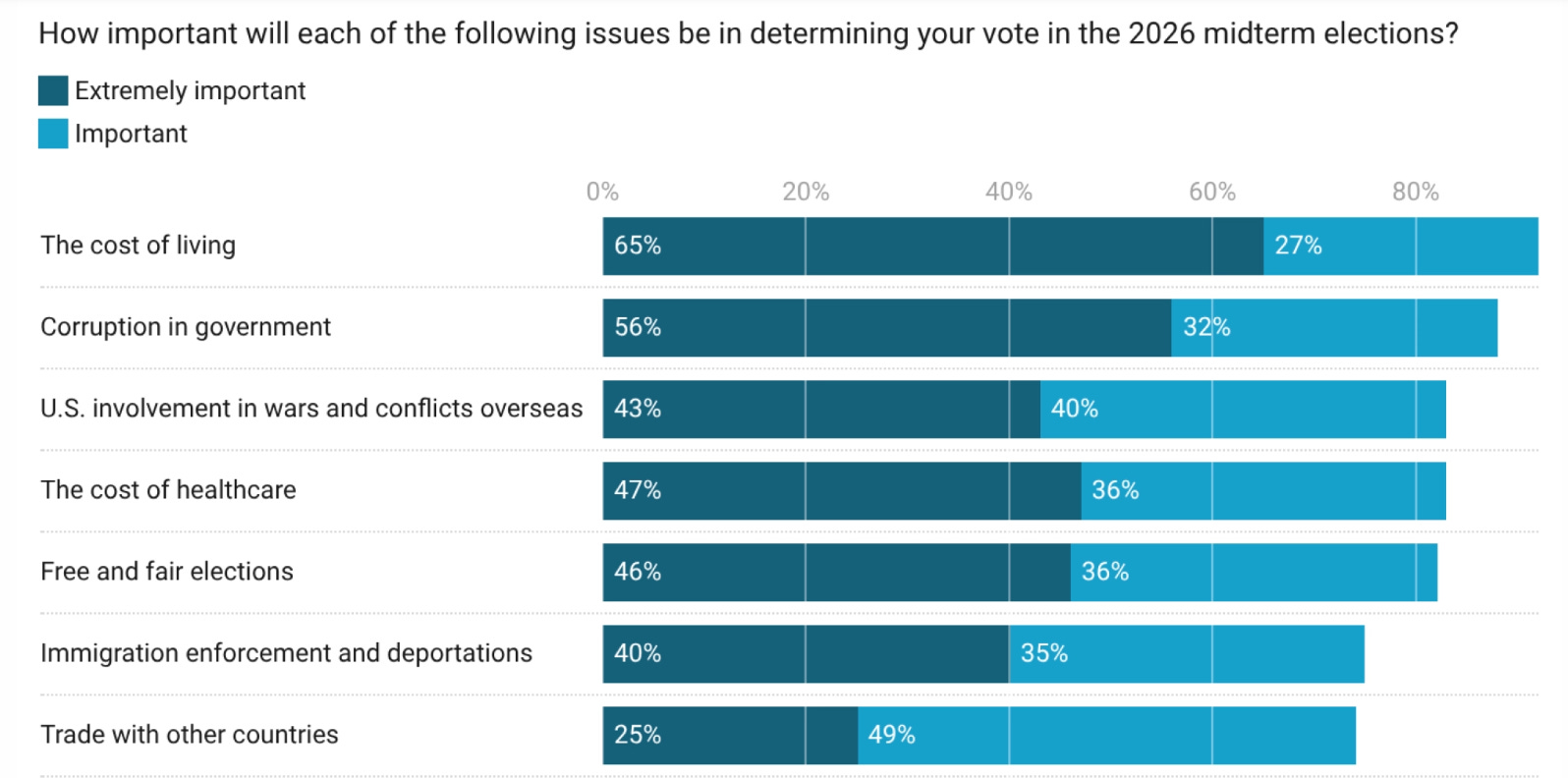
Today I’m hearing many of the same frustrations. Young Americans are worried about the cost of living, angry about corruption, and exhausted by war. Many are disappointed with the politicians they supported in 2024. They were raised on instant gratification (social media, Uber, dating apps) and are used to seeing things happen quickly — and expect the same from politics. When change doesn’t come fast enough, they’re ready to look elsewhere. More than anything, they want to know who’s actually going to make their lives better.
That’s why I was particularly interested in the latest Harvard Institute of Politics youth poll, released today. It’s one of the most comprehensive looks at how young Americans are thinking about politics, and its findings reinforce much of what I’ve been writing about.
The culture war is over. Young Americans are far more focused on the cost of living, corruption, and war over the identity politics that have dominated so much of our political debate.
* Read: The Everyday Issue Election *
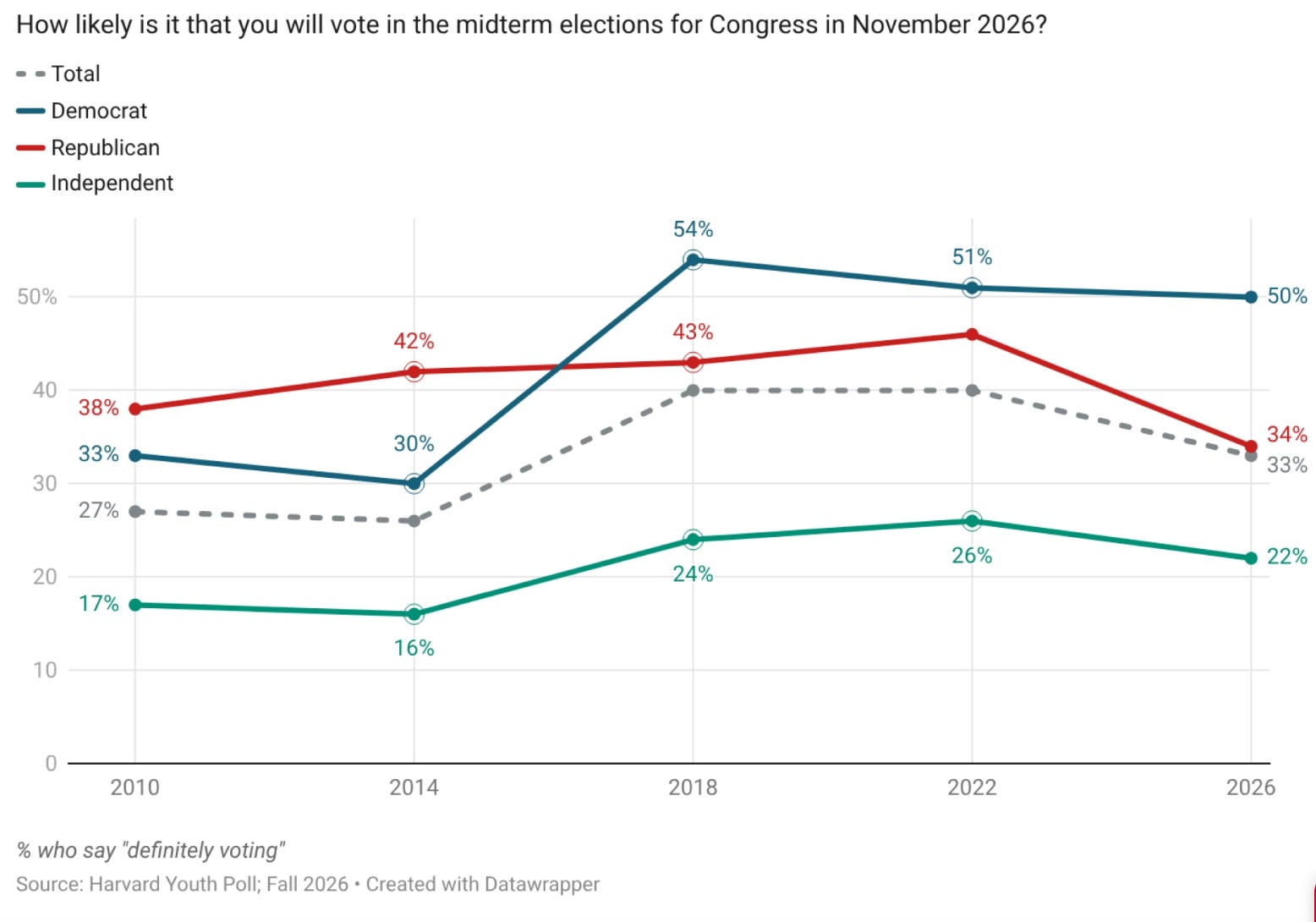
And despite how strongly they feel about these issues, fewer young people say they plan to vote in 2026 in either of the last two midterms.
Just 33% of young Americans say they’ll definitely vote in November, down from 2018 and 2022 – two midterms that saw high youth voter turnout.
The biggest drop is from young Republicans. Only 29% of “non-MAGA” young Republicans plan to vote.
This mirrors something I’ve been hearing in conversations with young voters – some of the same people who supported Trump in 2024 are already disappointed with what they’ve gotten, but that doesn’t mean they’re ready to embrace Democrats. A decent chunk feel politically homeless.
But there is some encouraging news for Democrats.
The Harvard poll shows they have a 21 point advantage with registered young voters.
That tracks with new analysis from the New York Times showing young voters moving sharply toward Democrats since 2024.
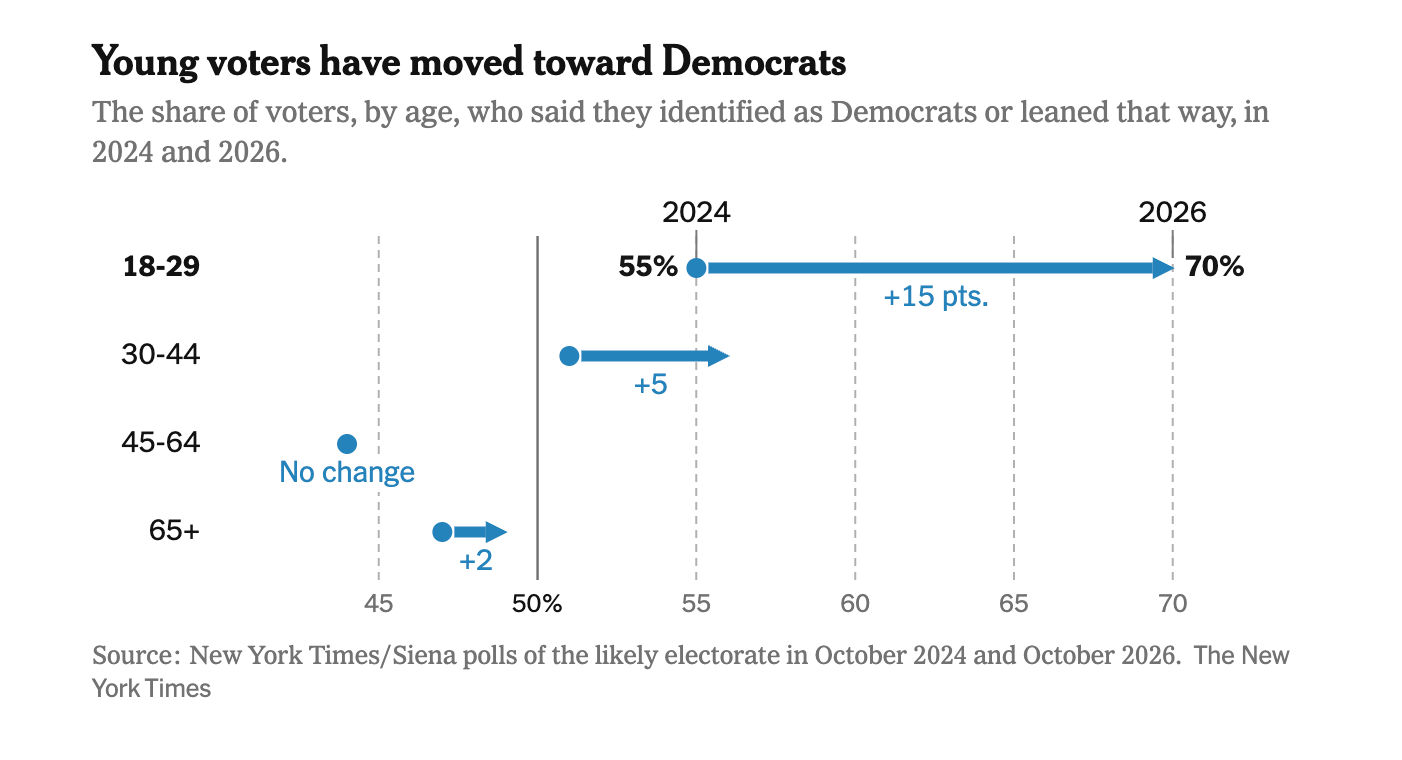
But the biggest mistake Democrats could make in the next few weeks (and years) is assuming that young voters moving away from Republicans means they’ve become Democrats.
That’s not what I’m hearing. Young voters are frustrated with the status quo, and they’re willing to change their minds when politicians don’t deliver. Some of the same voters who helped elect Trump in 2024 are now reconsidering their support, but that doesn’t mean Democrats have won them over, and even among young people who prefer Democrats, there’s a big difference between supporting a party’s ideology and being motivated enough to show up and vote.
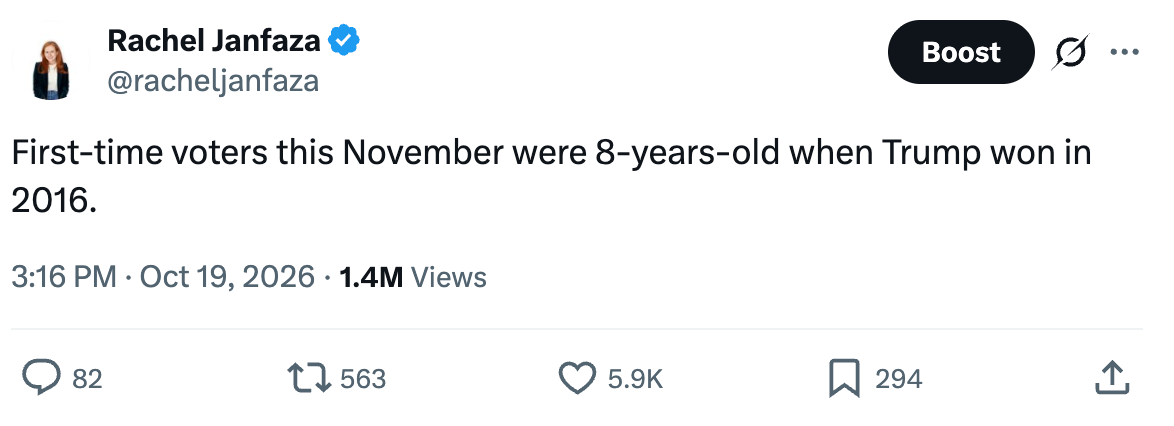
Plus, as a reminder, a Trump-dominated political ecosystem is our generation’s only point of reference.
On my radar – TX, GA, MI, Talarico, Ossoff and El-Sayed
But while young voters nationally aren’t as amped about this election as they have been in recent years, there are a few states where we could see high youth voter turnout, thanks to motivational candidates.
The names that keep coming up in our focus groups are James Talarico, Jon Ossoff, and Abdul El Sayed. And I wouldn’t be surprised if young people turnout in higher numbers in Texas, Georgia, and Michigan than in other states.
But don’t be fooled by why that is. Yes, all three of these candidates have a social media savviness that’s boosted their campaigns. But it’s not their social media savvy alone that’s resonating.
1. They’re authentic.
They each have a distinct and authentic style of politicking — all three of these men are very different, and their differing personalities work for them in their own states.
2. They’ve leaned into key issues.
In a focus group on the day of the Michigan primary, young voters in Michigan told me they appreciated El-Sayed’s emphasis on healthcare. Talarico and Ossoff have both focused on corruption.
3. They’ll go anywhere and talk to anyone.
Jubilee, Fox News, town halls, campaign rallies, Austin City Limits Music Festival… each of these candidates have successfully blended in-person engagements with on-camera moments, turning their on-the-ground engagement into viral clips. These moments allow those in the room — and viewers in their feeds — to feel like they’re there in the moment, which is different from filming in front of a green screen or manufacturing a made-for-social clip in hopes of gaining attention.
4. And they’re also taking the election seriously.
This is, perhaps, the most underrated quality that young voters have been telling me they care about.
Don’t believe me? Here’s what I’m hearing.