

The MAGA coalition is splintering, thanks to Gen Z and the rise of grievance culture.
The Manhattan Institute, a conservative think tank, clearly gets that. On Friday, the Institute’s City Journal published a partial transcript of a focus group they held with 20 right-leaning Gen Zers, and the internet went wild digesting the participants’ POV on everything from the economy, to AI, dating, racism, feminism, Hitler, and the Jews (yes, they went there).
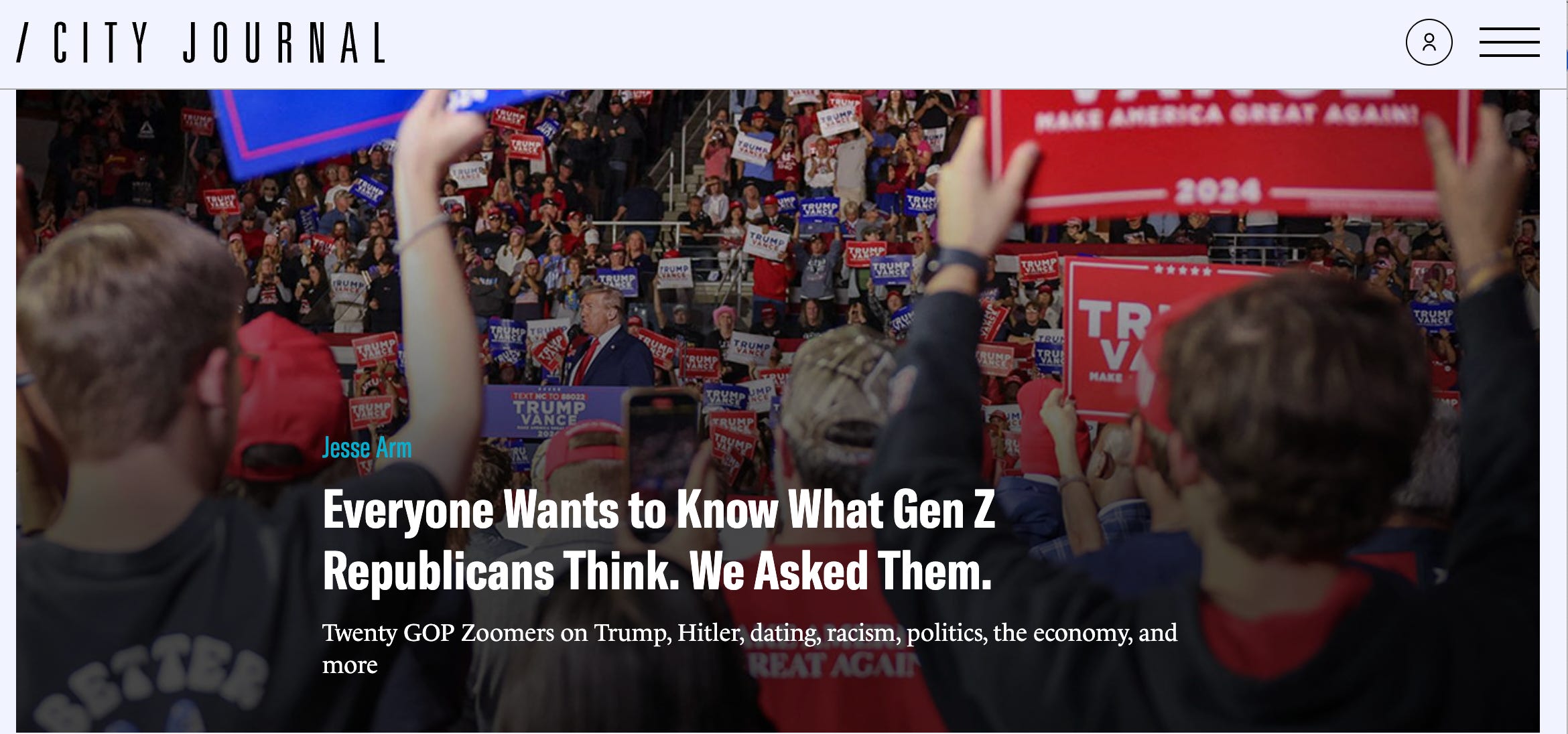
I’ve been thinking a lot about their findings. Some of what surfaced reflects what I’ve heard for years in listening sessions — for example, frustration over the steep cost of living and the daunting job market, an appreciation for a wide range of right-wing influencers (which I wrote about for the NYT in 2024), some of whom are quite controversial, the woes of modern dating, and a shepherding in of the rise of religion (as a way to counterbalance the chaos).
We know that Gen Z is widely disillusioned, distrusting, and bleeding compassion.
This focus group further proves that young people across the political spectrum are being drawn toward a politics defined by resentment to push back against what they feel has been a life lived in constant crisis.
This was one focus group, with one group of young conservatives in Nashville, Tennessee. But the results paint a dark picture of how young people today feel about their place in society.
The interviewer asked questions that I have not, which revealed worrisome truths about how cracks in our education and media ecosystem are manifesting in an appreciation for some of history’s most dangerous tropes and leaders. The first digitally native generation grew up in a media environment that rewards conflict and promotes an us versus them mentality. And this has consequences, when it comes to politics, dating, and life.
Here are some of the most telling questions and answers from the Manhattan Institute’s Gen Z focus group. You can read the rest here. I encourage you to do so.
Question: How is the country doing currently, and why?
“I feel like the country’s worsening, and really because of immigration, I feel like who is in the country makes up the country, and dictates what kind of country it’s going to be. And I don’t feel like the Trump administration is doing enough to deport people,” said Andrew, who’s 20.
Question: Who’s heard of Nick Fuentes?… What do you think of him?
“At its core I believe a lot of what he says, but I think the delivery is kind of poor. Like, I feel that way about Trump. [But] . . . He’s America First. He’s not anti-helping out other countries, but he’s like we can’t be putting our country at risk because of it, so I just think that general mindset is what I agree with,” said Ally, who’s 28.
“I dig him. He knows his market. He’s not trying to please everybody. He’s definitely going after more of the shock value with some of his stuff. But as far as general beliefs or values, I sort of agree,” said Atticus, who’s 25.
Question: Who wants to get married and have babies?
“Potentially. I’m a Christian and — no offense to any women here — but there’s not a ton of good traditional Christian women out there,” said Andrew.
“Well, I think that modesty is a virtue, but even modesty aside, I think if you look at the heart, you look at the values, people are not heavily leaning toward settling down or finding someone to build a life with. And maybe it’s because we live in Nashville and around Nashville. Everyone has Peter Pan Syndrome,” said Sophie, who’s 26.
Question: And how’s the dating market?
“You go on great dates, and then it ends after, like, 5 months. No one wants to stick through the uneven phase,” said George, who’s 29.
Question: What do the women here think about feminism?
“Hate it, and it shouldn’t be here,” said Lauren, who’s 26.
“Should women be able to vote? Yes. But should we be demoralizing ourselves as women and our true values? I used to work, and now I’m a stay-at-home mom, and there was a time where that was really frowned upon, and I think that that’s sad. I think that family culture and values have been diminished in our country,” said Ally, who’s 28.
Question: What is broken in the American economy?
“Health care. We’re busting our asses just to pay rent and health care that we don’t even use,” said Atticus.
“I can’t pay for insurance. I haven’t had insurance since I quit a job four years ago, so I don’t know what I’m gonna do if I have an accident. I’m just gonna be in debt,” said Brice, who’s 24.
“I don’t think that guy [Luigi Mangione] went about it the right way, but I can see where his frustrations were,” said Ashley, who’s 29.
Question: What do you think of Adolf Hitler?
“I think he was a great leader, to be honest. I think what he was going for was terrible, but I think he showed very strong leadership values,” said Ashley.
“I myself am actually Jewish, ancestrally. I’m Christian by faith, but Jewish by blood. I’ve actually read Mein Kampf. The end conclusions that he came to: absolutely abominable. But I strangely understood where he was coming from as far as wanting to improve the national state of Germany,” said Brice.
Question: What do you think of Jewish people?
“They’ve got Hollywood on lock,” said Atticus.
“Don’t they own, like, a ton of the media, and, like, just kind of everything?” said George.
“I would say a force for evil. I don’t see why we support Israel. I think Israel’s a very evil state. The genocide in Gaza, killing all these poor people. And the only reason we really support them is because they are the biggest donors. We have AIPAC, and these are all Jewish-run organizations,” said Andrew. Pressed to clarify, he replied: “It doesn’t bother me if it’s true. Those slurs, if you’re racist or whatever, that just rolls off my back… This is my country, my people have been here since the American Revolution, so I say what I want to.”
There was so much more — on Israel, America’s relationship with Ukraine, immigration, abortion, and other dicey topics. But I’ll stop there.
The group of young adults didn’t agree on everything. They’re split in how they feel about the current state of the country, figures like Fuentes, whether or not home ownership is possible, and immigration policy. Portions of the group are clearly hard-pilled on America First messaging, leaning into Christianity and nationalism, fed up with dating — and seemingly women — relying on content creators, and some think Hitler was a good leader. These themes are all related.
Growing up in constant crisis and a deficit of trust sure has its repercussions, and these are some of them. But beyond that, the findings of the focus group reveal what happens when you mix a lack of Holocaust education, a saturated media environment that rewards inflammatory rhetoric and divisive actors, and a vacuum of leadership.
In an overview of their findings, the Manhattan Institute writes that:
“Psychologically, this group was marked by desensitization, shaped less by fear than by boredom. They were not especially anxious about their own futures. They worried more about what AI and automation might do to other people than to themselves. Politics is entertainment: a stage for mockery, transgression, and performance, not moral seriousness or policy discipline.”
The Manhattan Institute somewhat glossed over an appetite for Hitler’s leadership style and blatant antisemitism. But the analysis above is pretty on-par with what members of The Up and Up’s Gen Z community have been telling me first hand about a growing generational desensitization to violence, crisis, and conflict and lack of empathy they witness amongst their peers.
The Up and Up’s take: That dynamic shapes how young adults relate to their friends, treat their neighbors, navigate dating and prospective relationships, and, perhaps most importantly, understand themselves and their place in the world. Without intervention, the results could be damaging.

In other news
Noteworthy reads
Young People Increasingly Hold This Bigoted Belief. How Do We Fight It?, Mary Harris for Slate
How The Phone Ban Saved High School, Anya Kamenetz for New York Magazine
Why My Generation Is Turning to ‘Financial Nihilism’, Kyla Scanlon for The Wall Street Journal
Ugh. Politics will stop seeming like a game to them as soon as they have to fight in a war they don't believe in, are trying to pay for treatment of a serious illness, need medical care that some politician decides to block on a whim, need to rebuild their lives after a fire/flood/tornado, try to start a small business ... in short, when they discover dysfunctional government is not "entertainment" but a way in which lives are wrecked.
Capitalize the word Christianity. Like you would capitalize Islam.