

On a call with The Up and Up’s ambassadors last month, one topic took over the conversation almost immediately: “skinny culture.”
As always, I asked about the biggest trends or most talked about topics between their friends these days. As if on cue, they started describing how it feels like everyone is looksmaxxing, i.e. doing whatever it takes to optimize for physical attractiveness — getting thinner, fitter, leaner, more sculpted, more conventionally attractive.
TL;DR everyone is chasing some version of a body they feel they don’t currently have.
This is, obviously, not new. But the version of skinny culture young people are describing right now feels different from the overt dieting culture of the 2000s. Back then, the messaging was often explicit — just be skinny. Today, thinness is wrapped up in the language of wellness, discipline, optimization, self-care, longevity, and self-improvement. In fact, the ideal body isn’t just supposed to be attractive, it’s now evidence that you have your life together.
These dynamics have been supercharged by algorithms that feed girls and boys content glorifying ultra-thin bodies by the minute, while simultaneously peppering them with content about food. And these norms have been co-opted by controversial content creators like Clavicular, the controversial social media creator infamous for bone smashing and promoting a new brand of toxic masculinity (you can learn about him here). They’re only more prominent in an era dominated by the rise of GLP-1s (which, obviously, are miracle drugs working wonders for millions of people who need them) and other peptides — which everyone loves to talk about even if they don’t really know what they are.
To be clear, GLP-1s are benefitting millions of people and can absolutely be life changing. But culturally their rise has also intensified online conversations around appetite, restraint, thinness, and bodily control. The food noise they may quiet for some can unintentionally amplify body image noise for others already struggling with comparison or insecurity.
The body image conversation historically has focused on young women. But these days, that’s not the full story. Young men increasingly face their own version of appearance pressure, too, whether it’s through an obsession with gym culture, protein fixation, bulking — or the fact that Clavicular chisels his jaw with a hammer. They all think it’s gone too far.
The reality, though, is that young women are far more prone to openly talk about their relationship with their bodies. The conversation may slowly be starting to shift among young men, though. Look no further than the Noah Kahan documentary on Netflix, in which the Gen Z pop-folk musician talks honestly about his own struggle with body dysmorphia. That kind of vulnerability from male public figures is still relatively rare, which is precisely why it resonates.
Zooming out, young adults these days are feeling whiplash from pop-culture and left-leaning media’s quick flirtation with body positivity during the Covid era — and the rapid shift away from it. The pendulum has swung hard and fast, all playing out visibly online and moving even faster than usual thanks to the speed of the internet. What once evolved over decades now seems to fully cycle every few years. It’s overwhelming.
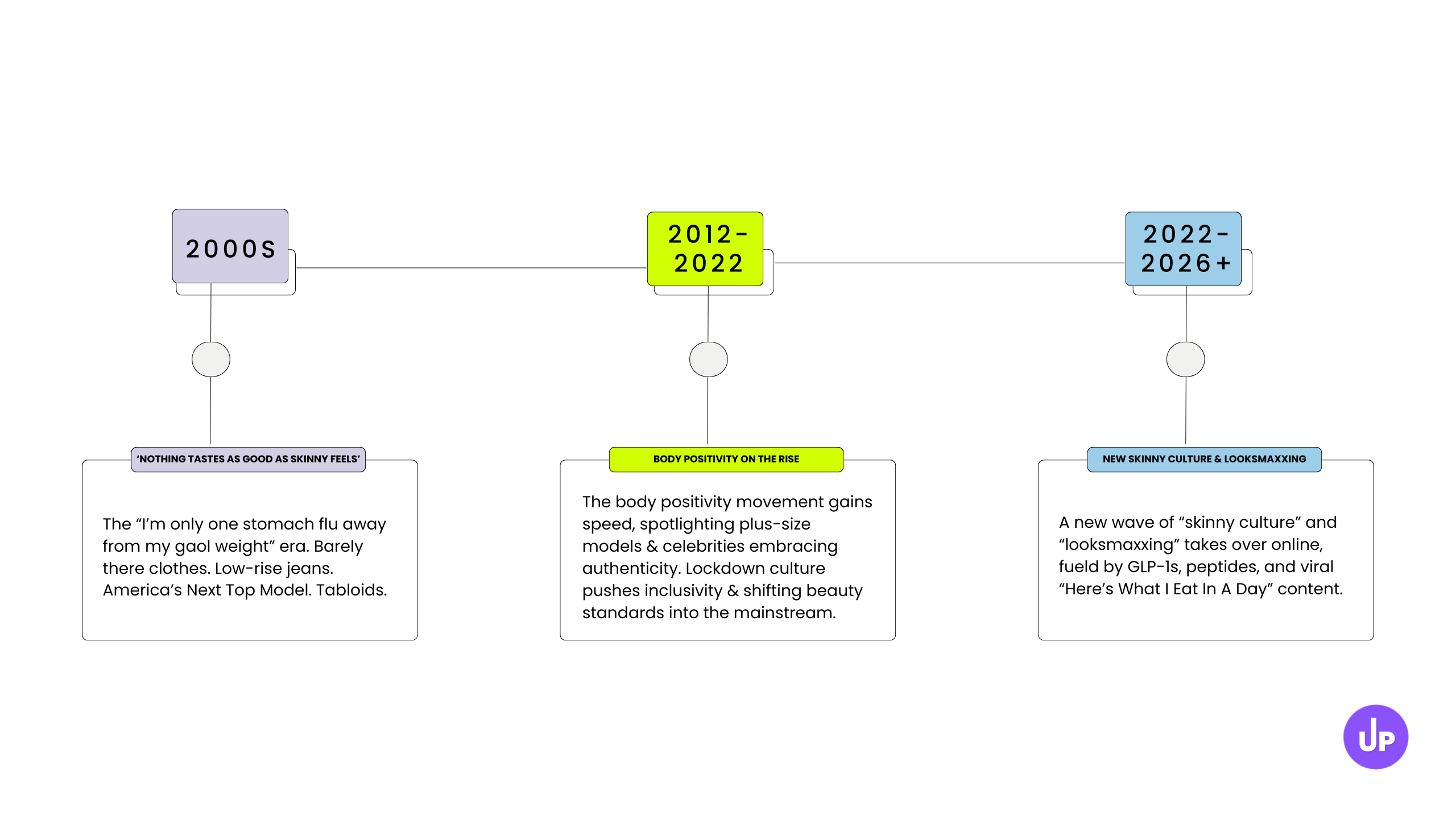
So I decided to dig deeper into these dynamics, asking The Up and Up’s ambassadors and community members what they’re seeing and feeling when it comes to body image and the “skinny culture” they say increasingly defines online life right now.
A few standout observations:
“Growing up as a Gen Z woman, body dysmorphia feels basically inevitable”
“This has gotten so much worse because of COVID”
“I’ve seen a lot of influencers post ‘what I eat in a day’ videos, which essentially sends the message that if you eat like me, you will look like me”
“There’s this weird contradiction where culture is obsessed with food visually, beauty campaigns with cakes, desserts, sugary perfumes, ‘girl dinner,’ cute matchas, baking content all while simultaneously glorifying shrinking yourself”
“Men, particularly teens/young adults, dislike the way they look due to comparing themselves to practically impossible to achieve unnatural body types”
“Looksmaxxing is essentially the degradation of the average male body presented to viewers as body improvement”
“In my gym everyone is wearing headphones and rarely talks to anyone else. So, many guys work out to look better for other people, but then no one talks with anyone else and is soloing their workouts”
