

Hi, it’s me, the girl who won’t stop talking about the two Gen Zs 🙋🏼♀️
ICYMI, in November 2024, I wrote the following:
In all of my work researching and analyzing Gen Z, I consistently see two distinct factions of the generation: those who graduated high school pre-Covid and those who really grew up during Covid. Surely, for anyone whose adolescence was impacted by a once-in-a-century global pandemic there are extreme social and emotional ramifications. Whether that meant entering a workforce disrupted by the pandemic, years of college Zoom classes and campus social distancing, or having high school and middle school defined by a year without much socializing at all, it’s had a massive impact on how we see the world.
But it hasn’t changed everyone in the same ways, and I’d argue that those members of Gen Z, who were younger at the peak of the pandemic, had a very different — and frankly harder — experience than those a bit older.
But Covid isn’t the only thing that has fragmented the experiences of Gen Z.
What might seem like subtle differences in age are exacerbated by the rapid speed by which social media has changed over the last decade. The habits of the older members of Gen Z (where I fall) vs. the younger members of Gen Z are distinct. Older members of Gen Z might have had a flip phone before an iPhone. Instagram and Snapchat didn’t exist until our time in late middle school. In high school (and most of college) there was no TikTok. But younger members of Gen Z have had an entirely different experience online. They only ever knew phones to be smartphones, with all the apps that exist today. They may be more prone to message on Snapchat than iMessage. And they are so acutely familiar with TikTok that they may not appreciate the way it’s transformed our culture.
Fast forward, and the case for the two Gen Zs keeps getting stronger.
A new Yale youth poll offers fresh evidence of a split within Gen Z — specifically when it comes to young men.
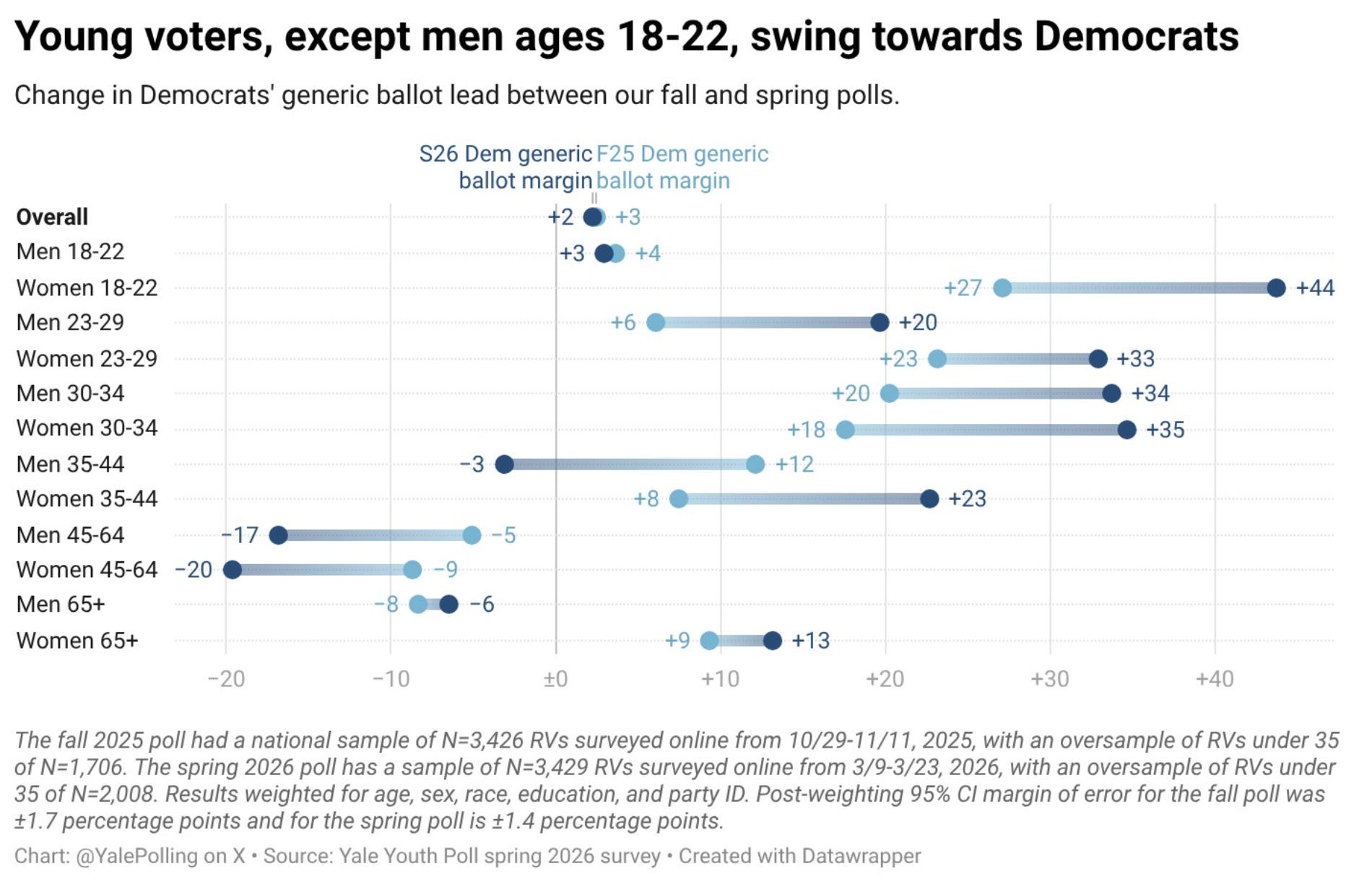
The data shows that young men are souring on President Donald Trump (according to the poll, “compared to the fall 2025 poll, Trump has lost the most ground with women under 35 and men under 30”).
‼️ But the poll also shows those young men aren’t necessarily moving toward Democrats ahead of the 2026 midterms.
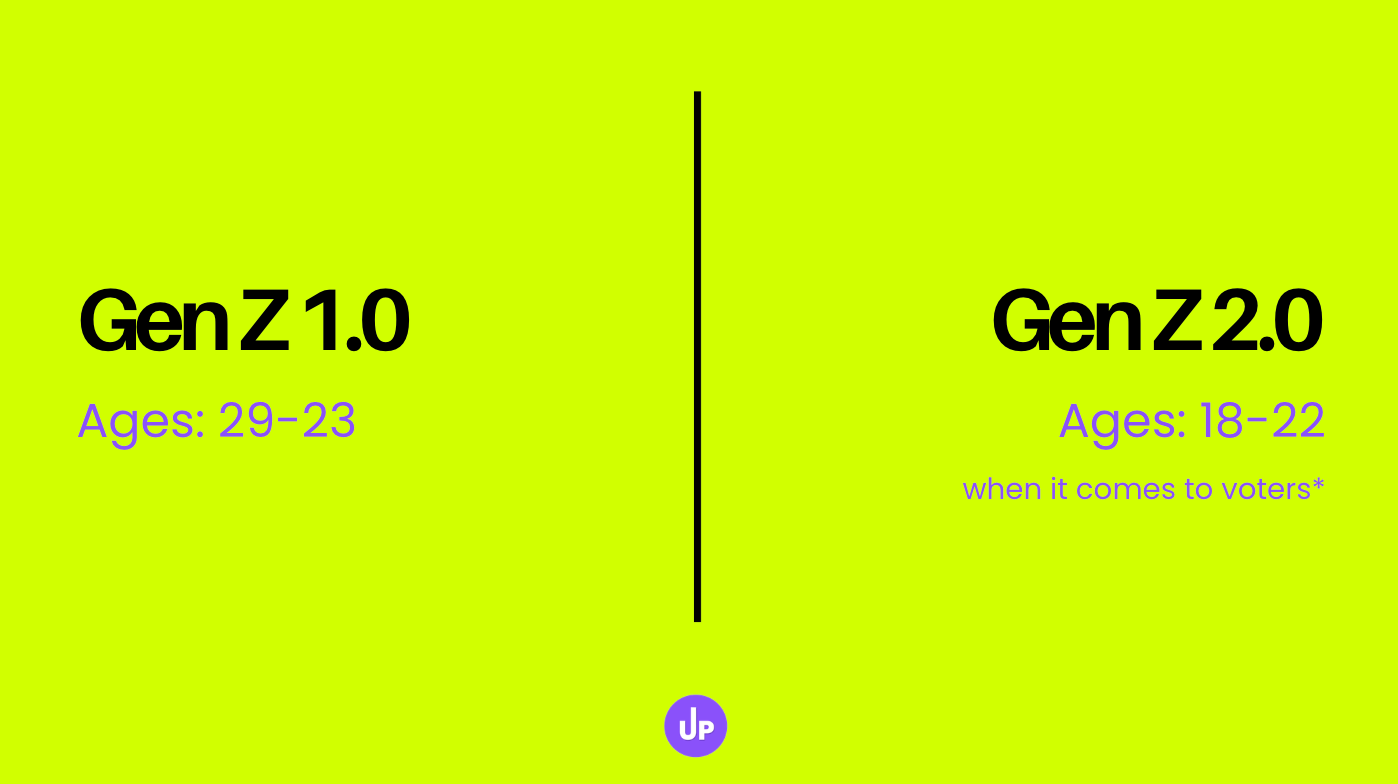
And there’s a big difference in support for Democrats amongst young men ages 18-22 (i.e. those in Gen Z 2.0) and young men ages 23-29 (i.e. those in Gen Z 1.0).
Among men ages 18-22 – Gen Z 2.0 – Democrats hold a narrow +3 advantage in a hypothetical general ballot.
Among men ages 23-29 – Gen Z 1.0 – that advantage is +20.
🚨 That’s a 17-point gap within the same generation.
The bottom line: When it comes to young men, Gen Z is not one political cohort. The men who came of age before Covid and before TikTok reshaped culture are politically distinct from those whose adolescence was defined by both of those factors.
Zooming out: The data also shed light on the pronounced and well established gender gap within Gen Z.
Young men ages 18-22 (Gen Z 2.0) lean just +3 points toward Democrats
While young women ages 18-22 (also Gen Z 2.0) lean +44 points toward Democrats
🤯 That’s a 41-point gap, one of the biggest we’ve seen to date.
So what? Gen Z is not behaving like a traditional generation of young voters when it comes to politics (nor are they really behaving traditionally in any aspect of our culture or society, fwiw). This cohort was shaped by the Trump-era, Covid, social media, and now AI. That combination has made their politics more fragmented, more reactive, and more shaped by culture in real time. It also helps explain why the divides within Gen Z, especially by age and gender, can be so stark.
On the whole, these young voters are less driven by partisanship and more driven by whether something feels like it’s working. They’re wired by instant gratification, and move at the speed of the internet. That has consequences.
They see everything happening in real time for them — what’s working, what’s failing, what’s happening, who is breaking through, who is losing ground. They want responsiveness and proof of action. This helps explain why this group can appear so swingy (and 56% identify as a political independent, according to Gallup).
They moved toward Trump in 2024 because they wanted results. And they’re moving away from him for that very same reason. They expected results they’re not getting.
Noteworthy reads
Top Influencers’ Secret Weapon for Engagement Might Be Replaced by AI, Andrew Zucker for The Hollywood Reporter
Relatedly, The Clip Economy, Ed Elson for Prof G Media
The Campus Protest Culture That Targeted Biden Goes Silent for Trump, Lauren Egan for The Bulwark
Relatedly, Why Aren’t The Kids Out Protesting Trump?, Thomas B. Edsall for The New York Times
Women in Their 20s May Not Be Having Babies, but by 45 Most Probably Will, Claire Cain Miller for The New York Times