


It’s almost America’s 250th birthday, and younger and older Americans are pretty divided when it comes to how proud they are of the country.
Recent data shows that *not shockingly* young Americans are less proud of the nation than any other age cohort — with only about one third saying they’re proud to be an American in two new polls.
Just 34% of young Americans ages 18-29 are proud of being an American according to a new poll from Public Religion Research Initiative. Meanwhile 66% of Americans 65 and older, 59% of Americans 50-64, and 43% of Americans ages 30-49 are proud of being an American, according to the same poll.
And just 31% of young Americans 18-29 are “extremely” or “very” proud to be an American according to a new NBC poll, while 75% of Americans 65 and older say the same. On the contrary, the NBC poll also found that nearly one-third (34%) of 18-29-year-olds “feel little to no national pride,” while just 9% of seniors said the same.
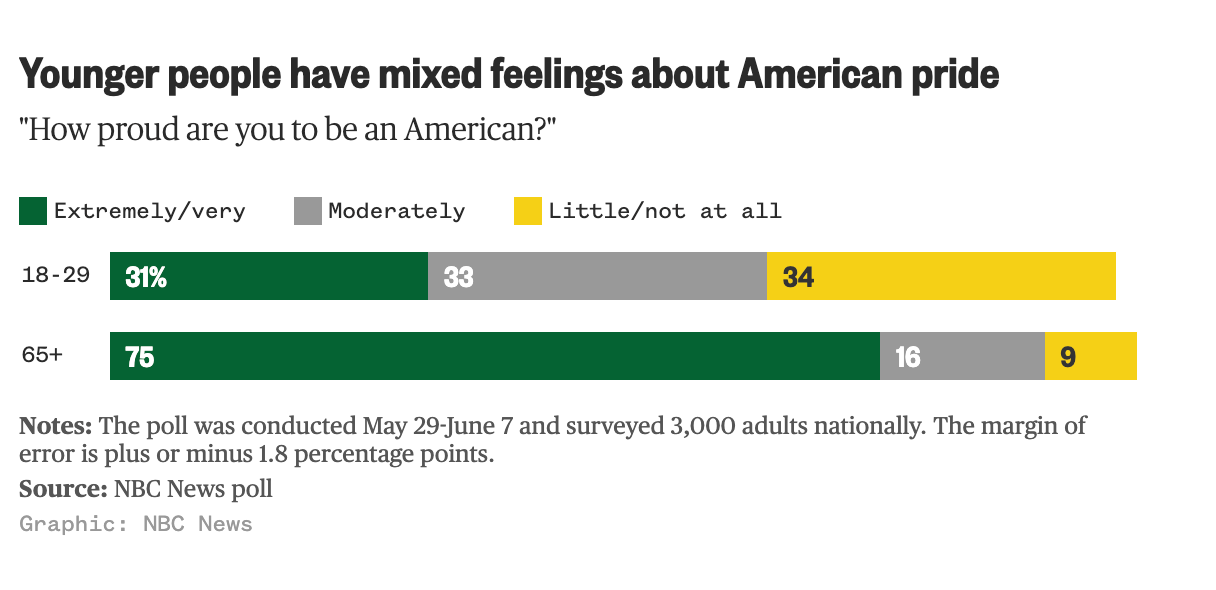
That’s a noteworthy drop from last year, when Gallup data revealed that less than half (41%) of young Americans ages 18-29 were extremely or very proud to be an American.
Zooming out, the country has seen some pretty bleak moments over the past year.
Political violence is rampant.
US immigration agents killed two US citizens in Minnesota.
Economic anxiety is sky-rocketing.
But there’s also a lot to be optimistic about.
We’re healing from the loneliness epidemic, coming together in person and outside (even if that means waiting in line).
The Winter Olympics and World Cup have given Americans something to rally behind as a country.
We’re hope-maxxing.
And next-gen political leaders are breaking through, offering some relief to years defined by the same two guys.
We recently asked our community members and fellows what patriotism means to them, and if they feel patriotic. Here’s some of what we heard:
“Patriotism is the idea of constantly working towards a better union and country. I don’t feel patriotic in the sense that I’m constantly proud of my country, but I love my country despite the fact I critique it relentlessly and do not approve of many of the actions my country has caused,” said an 18-year-old in Arizona.
“Patriotism means feeling proud of the country and supporting decisions made by political leaders. I wouldn’t necessarily describe myself as very patriotic but I do feel very lucky for all of the opportunities I have within this country,” said a 21-year-old in California.
“Having a strong spirit for your country. I don’t feel patriotic but I do feel like I have a duty to contribute for my country,” said a 17-year-old in Hawaii.
“Patriotism to me means loyalty to one’s country at the base of it. Currently, the term has been shaped by political rhetoric that excludes immigrant communities and individuals such as myself. It makes the current state of our country feel more divided and less welcoming to live in, especially for future generations,” said a 17-year-old in Arizona.
Truth is, the story of young people and their relationship with American patriotism isn’t as cut and dry as one might think.
We’ll be digging further into these dynamics and breaking down what more of our community has to say about American patriotism and the country’s 250th later this week, so stay tuned.
Noteworthy Reads
The Glitchy, Goopy Look of Now, Callie Holtermann for The New York Times
When AI Puts Gen Z in the C-Suite, Isabelle Bousquette for The Wall Street Journal
Taylor Swift’s Fans Have Been Training For This, Julie Beck for The Atlantic
I’m a Gen Zer who spends all day online. Mahjong gave me a reason to connect in real life., Amanda Geffner for Business Insider
The safest girl on the Internet, Chrissy Correa for Bustle