

There’s a mother-daughter duo building a skincare clinic for a generation who grew up getting health and wellness advice on TikTok — or now ChatGPT.
Dr. Amy Wechsler and her daughter Zoe opened their first acne-only clinic, ‘Spotless,’ on New York City’s Upper East Side last November. Less than a year later, they’ve opened a second location in Greenwich Village.
The walk-in skincare clinic is built around the reality that dermatologist appointments are both hard to get and expensive, and figuring out what to actually do about your skin means sorting through an overwhelming amount of advice online. Spotless quickly gained attention for making ‘the pimple shot’ — a steroid injection that reduces inflammation — available on demand for $100.
Spotless was built against the backdrop of teens and twenty-somethings getting more of their skincare advice from social media, where medical expertise, paid influencer recommendations, and misinformation can all show up in the same feed.
Dr. Amy Wechsler, a board-certified clinician in both dermatology and psychiatry, along with a team of licensed clinicians, offers an alternative: medical expertise, fast.
In some ways, it’s the GLP-ification of skincare. A generation that has watched medicine transform weight loss is increasingly comfortable looking to medical interventions for other problems too — and expecting solutions that work quickly. The fact that Spotless has already opened a second location says a lot about the appetite for on-demand skincare. It also raises questions about who young people are turning to for answers, what they’re willing to spend money on, how a new generation of medical treatments has changed expectations for what can be fixed — and how quickly.
I spoke with Zoe Wechsler, the Gen Z face and brain of Spotless, about it all. Here’s our conversation, edited for clarity and brevity.
I saw a funny reel the other day about how millennials covered a pimple vs. how Gen Z covers a pimple. Where do you see generational divides in perceptions of, and stigma around, acne?
ZW: Our biggest patient demographic is 23 to 39. We see that spectrum. We sell Clinique acne safe concealer at Spotless and a lot of the patients on the older end will want to cover up [a mark] before they leave. If you have a pimple shot or an extraction, you’re a little bit red for like an hour or two. They’ll want to conceal it, or they want to use a pimple patch, or they’ll have a pimple patch packet of the clear ones in their bag just to cover it. And then our Gen Z, younger patients are just like, ‘No, I’m good.’ They’re like, ‘I’m fine.’ Or they’re like, ‘I have stars at home. I’ll put them on.’ It’s very much celebratory versus the, ‘this is such an inconvenience mindset.’
Your customers are seeing their skin on a screen all day. How has technology shaped our generation’s relationship to our skin?
ZW: It makes it a lot worse because we see patients all the time who come in and are like, ‘Do you see this on my face?’ And our clinicians can look with a magnifying mirror and they basically see nothing. We’re so much more hyper-sensitive to tiny things that come up on our face. And a lot of the time a pimple is so small that you can’t inject it safely or you can’t extract it. And if you weren’t seeing other girls’ faces all day on your phone or filming your own face, you wouldn’t even notice it if it’s that small. So I think it makes us more nit-picky, which I think can be damaging, especially if you’re someone who’s prone to picking. You can create scars.
What’s the worst piece of viral skincare advice you’ve had to undo?
ZW: Two things. Bone smashing. And beef tallow, which isn’t necessarily so damaging. It’s just disgusting and will make you break out more.
*Note from The Up and Up: For those unfamiliar, bone smashing, i.e. smashing one’s face with a jaw or hammer, hit the mainstream when controversial internet personality Clavicular, notorious for looksmaxxing, brought the term and dangerous practice into Gen Z’s vernacular.*
Do you see a gender divide in your clientele? Do young men come in, are they as prone to coming in — or is there a stigma there? And is the bone smashing more prevalent amongst young men than young women?
ZW: Yes. But the beef tallow is definitely split. When we were building the brand, it had to be gender neutral, because acne affects everybody no matter your age, your race, your gender, your socioeconomic status. Everybody gets acne. So you have to feel like you belong here, because you do belong. Everybody with acne belongs at Spotless. We try to do a lot of demystifying on social, [telling] guys to come in.
I would say about 40% of our patients are men, which is amazing. All ages. A lot of teenage boys, they come with their moms or they come with their sister. Younger guys come in with their girlfriends or wives. But a lot of guys just come in on their own.
A lot of young people get skincare advice from TikTok/Instagram creators before doctors. Are you competing with that ecosystem or building on it?
ZW: I think we’re trying to set ourselves apart in that ecosystem by using science and clinical evidence as opposed to being like wellness-ey and not having any science to back us up. When we discuss curing acne, some people don’t agree with using medicine to treat acne, but it’s hard to argue with science. My mom’s a dermatologist and a psychiatrist. We use her voice and her platform and her 20 plus years of experience in treating acne as our voice. And because she’s a child and adolescent psychiatrist as well, she can speak really well to younger people without feeling like they’re being talked down to or judged.
Your premise is that you can’t get a dermatologist appointment when you need one. Is that a Gen Z problem, or a healthcare-system problem?
ZW: It’s a healthcare system problem. We have patients of all ages who come in, patients well into their 30s, who’ve been dealing with acne since their teens, who have been to 10 different doctors or tried to get into derms, and they hit roadblocks everywhere they go and they just give up. A lot of patients of ours have just given up on treating their acne which is really sad and not necessary. But you know, you try to see a dermatologist in network and you wait three months to see them and they spend four minutes with you. You don’t get answers, you don’t get a full picture of your family history, of medicines you’re on, etc. You’re not going to get comprehensive acne care. So, that’s a big thing. And then even if you do have a dermatologist that you like, it’s just hard to see them, especially for pimple shots.
Walk me through the cost of this — do you take insurance? Is this something you’re trying to make more accessible for people who can’t afford it?
ZW: We don’t take insurance. We provide every patient with a filled out super bill insurance receipt that they can submit to their insurance provider. Our consultations are $275. It’s our most expensive appointment.
And our pimple shots, up to three pimples, are $100. Extractions as well. Consultations actually include pimple shots or extractions if you need them. So we try to make it accessible as much as we can.
Are you seeing young patients treat your service like other splurges or priorities in wellness culture?
ZW: We’re seeing it as a priority. We are a medical clinic and so we are different from botox and other aesthetic clinics, different from a massage or acupuncture. We try to really position ourselves as medical, but we’re as accessible as any other wellness studio. So I do see patients prioritizing it.
Gen Alpha and skincare are somewhat synonymous. What’s the youngest you’ve seen someone come in? And how/why do you think skin care differs even between Gen Z and Gen Alpha?
ZW: We can treat patients as young as eight. We haven’t yet. I believe our youngest patient right now is 11. But we definitely treat young people. Acne starts around puberty. So that can be at varying ages for different people, but a lot of them, they come in and our clinicians our first question when you’re really young is, ‘What do you do with your skin?’ And a lot of the time it’s just starting with, ‘Do you wash your face with soap?,’ starting really basic, because a lot of the time they’re just so young they haven’t started or they don’t know. So they come with the parent and we discuss what they are doing. Sometimes the kids don’t wash their face, they don’t put water on their face, they don’t get their face wet in the shower. So, we really just start there. And some kids come in and they’re using a hundred products that they convince their mom to let them buy. So, it’s usually one of the two. It’s either toning down the amount of products and seeing what’s actually going on or introducing a gentle skin cleanser and going from there.
Do you see differences in how Gen Alpha thinks about their skin compared to Gen Z?
ZW: Gen Alpha is more parent led, Gen Z is more TikTok led.
We’re in an optimization era: GLP-1s, wearables, AI. Everything that used to take time now has a shortcut, including a pimple. Is Spotless part of that trend?
ZW: I think the accessibility of pimple shots is part of that trend. It used to be you could only get pimple shots if you knew someone, you had an in with your derm, or you were a celebrity. [Now] you can be in and out of Spotless in 15 minutes if you need, if you are in a rush. So that I think is part of it. People do try to make it quicker in terms of starting an [acne] medicine at a high dose to optimize it. That doesn’t always work and that can lead to uncomfortable side effects. Nothing dangerous but not great. But I do think that the accessibility of a pimple shot is totally part of that.
And what does this say about our generation’s expectation for instant gratification?
ZW: I think it makes it tough when you’re talking medically because acne medication, regardless of how far we’re advancing, takes six to eight weeks to start working.
That patience is harder earned than it used to be.
What’s it like to be the Gen Z co-founder of a business with your mother? Where do your instincts clash?
ZW: The funny thing about working with my mom is probably not what you expect me to say, which is that she’s always right. But we agree on so much, I think because we have this shared mission of curing as much acne as possible. On a rare occasion, if we’re disagreeing on something strongly, that means that something is pretty important. If we’re really disagreeing, if we see something completely differently, we just hear the other one out. We sometimes bring in our COO’s opinion or we bring in the clinical team or our social media team just to have another opinion. But usually we actually do agree because all we want to do is take care of people, and so the nitty-gritty of that can be challenging, but we do agree.
What’s fun about being the Gen Z co-founder is teaching her about fun stuff or like right now we’re working on a launch and she’s very used to old-fashioned media and press and long lead times and all these things, but I’m like, ‘Well are we doing this, and it’ll be done next week.’
On My Radar
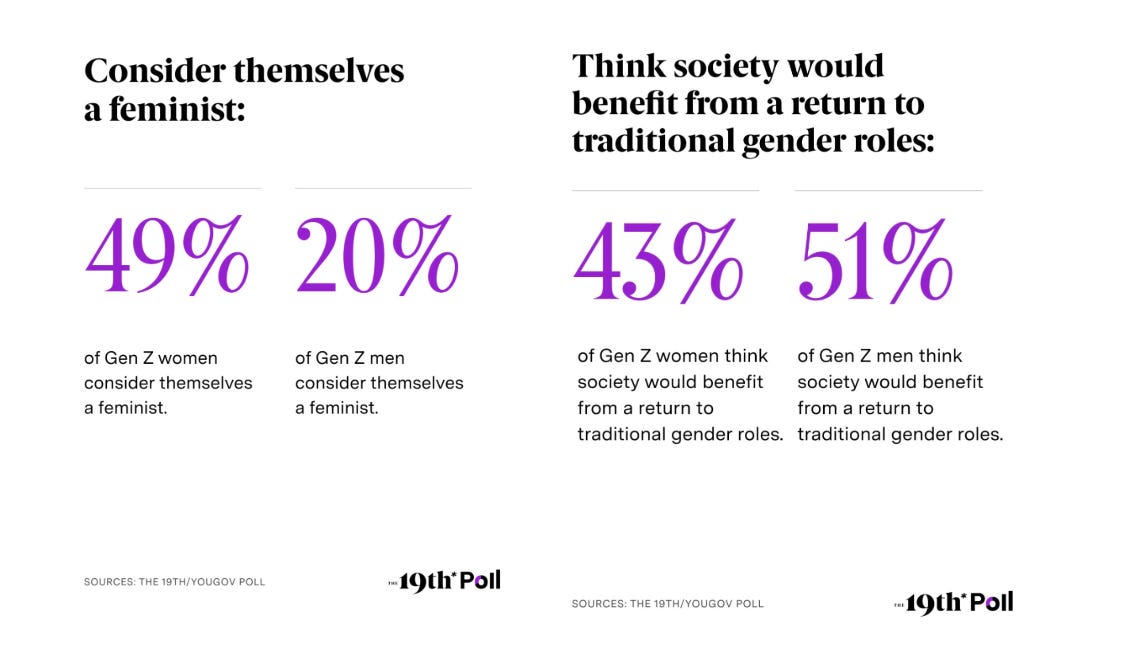
While Gen Z voters tell us they’re ready to move beyond the gender war, the gender gap still exists, according to a new poll from The 19th* and YouGov which found discrepancies amongst young men and women on a range of topics.
The divide in young men and women’s POV is old news. What's more noteworthy to me is the significant share of young women rejecting feminism and longing for a trad-lifestyle.
ABORTION: 69% of Gen Z women believe “abortion should be mostly or always legal,” while just 51% of Gen Z men say the same.
TRADITIONAL GENDER ROLES: 43% of Gen Z women believe “society would benefit from a return to traditional gender roles,” while 51% of Gen Z men say the same.
FEMINISM: 49% of Gen Z women “consider themselves a feminist,” while just 20% of Gen Z men say the same.
Noteworthy Reads, Watches & Finds
Reads:
The Post-Me Too Generation Gets Its Me Too Moment, Zoe Yu for New York Magazine
Sam Altman Sees the Future. Are We In It?, Mark Guiducci for Vanity Fair
Mayors Are Filming Videos, Mamdani-Style, With Varying Degrees of Cringe, Julie Bosman for The New York Times
Watches: SNL…. I was so excited for the new season to start. My fiancé and I have a tradition of watching it every Sunday (or this week, on Monday). Some sketches don’t hit. Yet we still turn it on every week. I’m a big fan of the Gen Z cast members getting their moment — Marcelo Hernandez, Jane Wickline, and Kam Patterson.
Finds: Speaking of skincare… I’m constantly re-upping my supply of Sofie Pavit everything. Even though summer’s over, I’m wearing their Screentime sunscreen every day (and not just because I’m a redhead).