

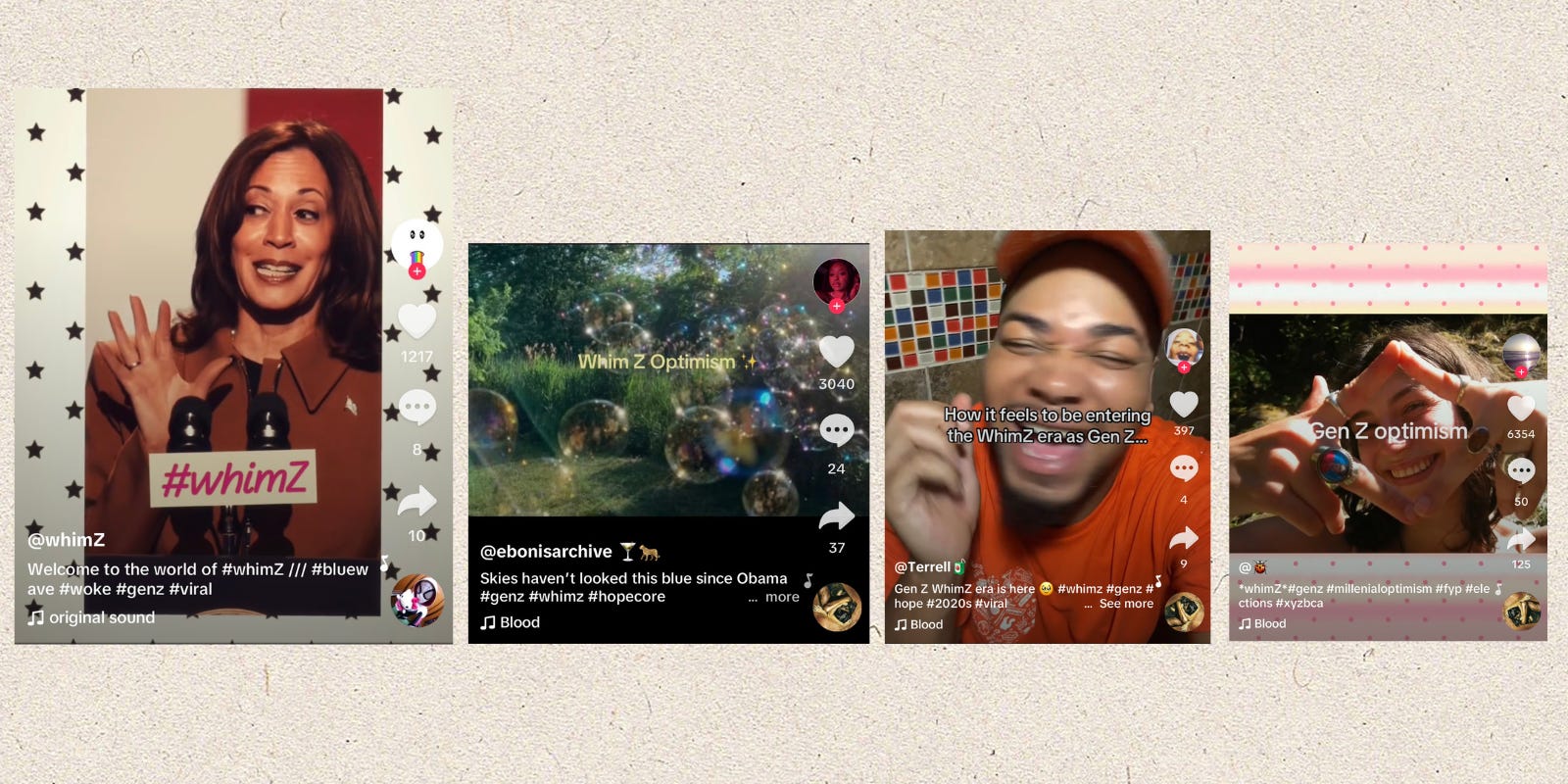
Millennials watched the election results last week and remembered what it felt like to be young and hopeful. Some of today’s youngest voters were getting that feeling for the first time. Now comes the debate over what to call it. Millennials see the return of Obama-era optimism while Gen Z is calling it ‘WhimZ,’ which gives that optimism a qualification: being excited and hopeful about the future doesn’t mean they expect that hope to actually lead to results.
The appetite for something better was there long before the election. Nearly a year ago, we wrote in our 2026 predictions that “growing up in crisis and constantly complaining about it is no longer fun — for anyone.”
Turns out we were right. Instead of romanticizing the past, Gen Z is finally living for the present.
Perhaps the most widely followed millennial politician, Rep. Alexandria Ocasio Cortez put what she called “millennial optimism” this way:
“This earnestness, imagine all the seats we flipped last night, that feeling, plus on top of it, electing the first Black president ever. And on top of that, you did it the first time you ever voted? That hits generationally. Like you are chasing that feeling ever since. And because you did it the first time you ever voted, you’re like ‘Yeah we can change the world. Yeah why not. We did it the first time. Why not just do it again?’”
But calling this a return to millennial optimism misses something about the youngest voters — they have nothing to return to. Young people online are calling what they’re feeling “WhimZ”, and they’re drawing the distinction that they’re hopeful but they know how much still could go wrong.
As TikToker @bearclawharley puts it:
“I’m going to be very blunt. Gen Z’s whimZ is very different than millennial optimism. And the reason why is us as Gen Z know that we still have to fight, we still have to keep pushing for what we want and to change the world. Where millennial optimism is like, ‘Great, everything’s going well and it’s just going to work out in our favor, and we don’t have to do anything.’ And this is no hate to millennials, you guys were promised to follow the rules and you guys will get a good job and yada yada. We as Gen Z know that that’s not going to happen. You guys were just carefree, we are ironically doing this. We are very optimistic, but it’s a sense of nihilism where we’re like, ‘you know what. We’re just gonna be, we’re going to be happy anyway, we know we still have to fight, but we’re just gonna have fun. Because that’s what it is. We know that it’s not going to work out the way we want it to so we’re gonna keep fighting and keep pushing and keep grinding and that’s how it’s gonna be.’ And that’s what WhimZ is vs. millennial optimism. Because it’s not just optimistically blindly thinking everything is going to go well.”
Hopemaxxing realized
I call the phenomenon hopemaxxing and wrote in our 2026 youth vote roadmap that young people are hungry for “forward looking policies” and candidates who have a “plan to fix — rather than maintain — the status quo.”
“Young people are looking for candidates to inspire. They’re tired of candidates who just blame the other side.”
This manifested in the success of next-gen candidates like James Talarico, Annie Andrews, Jon Ossoff, and so many others last week.
Millennials are surely having their political moment — but their wins (and campaigns) were powered by Gen Z voters who are tired of a constant aura of doom and gloom that’s colored their adult lives.
Gen Z is sick of doomscrolling, longing for everything in-person, and ready to feel good. They’re leaning into things that used to be called ‘cheugy’ like malls and digital cameras and low rise jeans — acting as if they’re discovering these things for the first time, because for them, they are.
That feeling has translated into their politics. Young voters are over the culture war and toxic political dialogue that spends too much time bullying or name-calling and not enough time working on solutions to combat today’s biggest challenges (which they’re feeling the impact of every day).
This is largely driven by Gen Z 2.0, the younger half of Gen Z, and the first-time voters who were just 8-years-old when Trump was elected in 2016. They were in middle school during Covid. To them, these phenomena are brand new.
*Read my piece ‘Beyond Bullies’ from March on the tactics and candidates catching young voters’ eyes*
They’re more interested in a politics of civility, in politicians of “character,” and in candidates who “lead with love.” Remember before the election, they told me they liked that Talarico was a “unifier.”
Sounds cheesy for a generation that’s so wildly jaded. But that’s the thing. Gen Z isn’t naive to the fact that even if they’re optimistic, get involved, do the right thing, organize, vote, they still might get let down. They’ve been through this before.


They’re also not overwhelmingly liberal, they’re just practical. Unlike millennials, who were more likely to slap a party label on their ideology when they were their age, according to Gallup data, Gen Z is more likely to be independent. They’re critical thinkers (as much as everyone likes to say they’re not).
Young people today have seen the challenges and danger of reflexive partisanship and unconditional party loyalty – including when it manifests in political violence and chaos (let’s not forget, we’re not so far away from January 6). That party loyalty is not built into their bones as it is for millennials — they know that politicians on both sides of the aisle can, and likely will, let them down.
They’re feeling the rising cost of living, worried about the threat of AI, aware that the entry level job market is grim, and unsure of where they’ll get healthcare. They know that gun violence still plagues the country, climate change is impacting the globe, racism, homophobia, and xenophobia have not been solved.
But even if they’re jaded, they’re not disengaging. An estimated 27% of young voters turned out in last week’s midterms, according to an early estimate from CIRCLE at Tufts, marking the second highest youth turnout rate in the past 30 years (on par with 2022 and second only to 2018, which saw record high youth voter turnout for a midterm election).
The question heading into this election was what would give young voters a reason to show up, and whether the constant struggle with affordability was as motivating as threatening issues in past midterms. But being fed up with the status quo, corruption, war, and a desperate desire for change — was. And the candidates who leaned into that most saw the most success.
On My Radar
Next-gen Democrats are giving major back to school vibes on Capitol Hill this week.


Noteworthy Reads, Watches, and Finds
Reads
SNL Had a ‘First’ This Weekend. It Says A Lot About the State of Hollywood., Naidra Goffe for Slate, What Constant Surveillance Is Doing To Children, Sarah Zhang for The Atlantic, 20-Somethings Are Ditching Entry-Level Jobs to Become Their Own Bosses, Ray A. Smith and Lindsay Ellis for The Wall Street Journal.
Watches
I joined Aaron Parnas last night to to talk about the role young voters played in the midterms and why Gen Z really is the swingiest of voters. Check it out.
Finds
The Sephora sale is sadly over, but I was influenced by Guizio’s Lauren Fishbein to try this Bobbi Brown crystal eye shadow stick, and I love it.